What Is Link Building? Complete Guide for SEO

Link building is the process of acquiring hyperlinks from other websites to your own. It is one of the top ranking factors in Google’s algorithm: the more high-quality, relevant sites that link to you, the higher your site appears in organic search results. This guide covers every type of link building strategy, techniques used in Ukraine and internationally, popular link marketplaces, and a step-by-step blueprint for building a strong backlink profile.
Link building is one of the three pillars of SEO, alongside technical optimization and content. Without a strong backlink profile, competing in high-difficulty niches is nearly impossible — even with a technically perfect website.
What Is Link Building and Why Does It Matter?
In plain terms: link building is the work of getting other websites to mention yours and link to it.
Google treats such mentions roughly as recommendations: if respected industry resources link to a company, trust in it is higher, and search shows it further up.
Why this matters to your business: without this, a site can be technically flawless and full of excellent content yet still lose to competitors who are simply talked about more often.
Link building refers to the practice of acquiring hyperlinks from external websites pointing to your own. In 1998, Google patented the PageRank algorithm, which first measured a page’s “authority” based on the number and quality of links pointing to it. The mechanics have evolved dramatically since then, but the core principle remains: a backlink is a vote of confidence from one site for another.
Today Google uses over 200 ranking signals, and backlinks consistently rank in the top 3. But quantity alone is misleading — quality, topical relevance, and the naturalness of your link profile matter far more.
How Backlinks Influence SEO
Every link passes two signals: that your site is worth attention, and what it is about.
So what matters is not how many links you have but where they come from. A single mention on a specialist resource in your industry weighs more than a hundred on random sites about nothing in particular.
Why this matters to your business: this directly decides what is worth paying for and what is not. An offer of “1000 links for €20” will, at best, do nothing at all.
When an authoritative, topically relevant site links to your page, Google receives two signals:
- Authority (PageRank) — “link equity” flows from the referring domain to your page, boosting its ranking potential
- Trust (E-E-A-T) — citations from trusted, well-established resources reinforce your site’s credibility in Google’s evaluation
Beyond rankings, link building accelerates indexation: Googlebot crawls the web by following links, so a new link on an authoritative domain can lead to your page being discovered within hours.
Types of Backlinks in SEO
Links are not all the same. Some pass authority to your site; others are technically marked so that they pass nothing. Some you placed yourself — in a profile on another platform, for instance — and some were placed by other people.
Why this matters to your business: when a contractor shows a report with a hundred links, only a portion of them actually work. Knowing the types lets you ask one simple question: how many of these really pass anything?
Before diving into link building methods, it’s important to understand the fundamental link types:
- DoFollow — passes PageRank from the referring domain. This is the “standard” link Google uses for ranking signals
- NoFollow (rel=”nofollow”) — does not directly pass PageRank. However, Google may still use these as a signal. Common in blog comments and forums
- UGC (rel=”ugc”) — marks user-generated content: comments, reviews, forum posts
- Sponsored (rel=”sponsored”) — mandatory for paid or affiliate links. Google requires this for any link acquired through link marketplaces
A natural link profile includes all types: dofollow and nofollow, branded and keyword-rich anchors, links from diverse site types. A profile consisting entirely of exact-match dofollow links looks manipulative to Google.
Types of Link Building: From White-Hat to Black-Hat
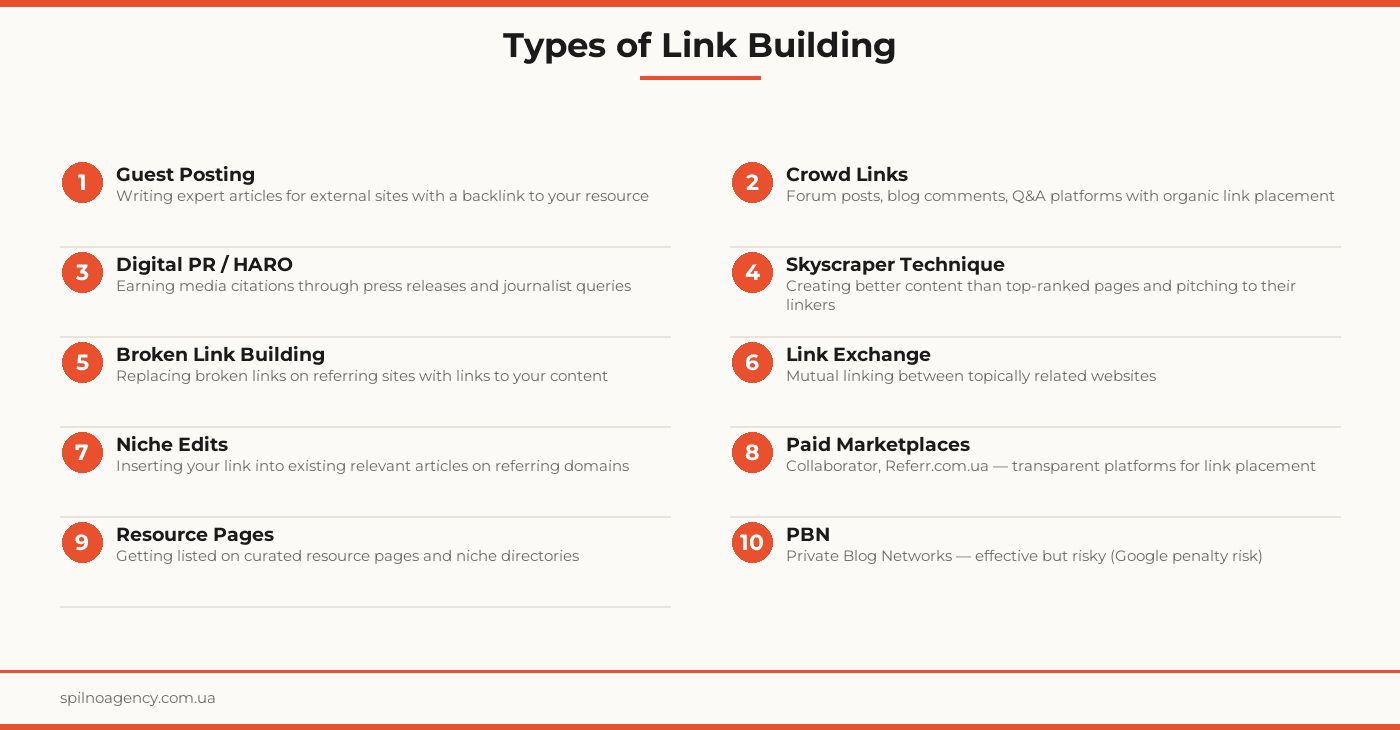
Link building spans a wide spectrum — from fully safe (white-hat) to risky (grey-hat) to prohibited (black-hat). Here are the most widely used approaches:
1. Guest Posting
The most common and scalable white-hat method. You contribute a high-quality, original article to another website and receive a contextual backlink in the body or author bio. The key: genuine editorial value and topical alignment between your content and the host site’s audience.
2. Crowd Links
Strategic placement of organic links in forum discussions, blog comments, Q&A platforms (Quora, Reddit, Stack Exchange). Effective for building a natural-looking link profile, but execution matters — spam-style posting damages your brand and can be flagged by Google.
3. Digital PR and HARO
HARO (Help a Reporter Out), Qwoted, and ProfNet allow you to earn backlinks from major publications — Forbes, The Guardian, Wired, TechCrunch — by providing expert commentary in response to journalist queries. One successful placement can deliver a DR 70+ backlink and brand exposure simultaneously.
4. Skyscraper Technique
Brian Dean’s methodology: find the most-linked content in your niche, create a substantially better version (deeper, more current, better visualized), then reach out to sites linking to the original and pitch the upgrade. Requires strong content production but delivers highly relevant editorial links.
5. Broken Link Building
Use Ahrefs, Semrush, or Check My Links to find dead (404) links on relevant websites. Contact the site owner, notify them of the broken link, and suggest your relevant content as a replacement. Win-win: you improve their UX and earn a contextual backlink.
6. Link Exchange
Direct reciprocal linking (A→B, B→A) is detectable by Google and can result in devalued links or a manual penalty. Safer variants include triangular exchanges (A→B, C→A) or guest post swaps. Keep exchange links below 5–10% of your total profile.
7. Niche Edits (Link Insertions)
Reaching out to owners of relevant, established articles and requesting insertion of your link into the existing content. Can be a paid or reciprocal arrangement. Links benefit from the existing authority of an older, indexed page — often more effective than a fresh guest post.
8. Resource Page Link Building
Find niche “resource pages” (curated lists of tools, guides, or useful links) and pitch your resource for inclusion. Search for: “your topic” + “useful links” or “resources”. Most effective when you have a genuinely valuable tool, guide, or dataset to offer.
9. PBN (Private Blog Networks)
Networks of privately owned sites built specifically to pass link equity to target sites. Technically effective in the short term but directly prohibited by Google’s guidelines. Risk: manual penalty or algorithmic Penguin filter. Used primarily in grey/black-hat SEO.
10. Paid Links via Content Marketplaces
Transparent acquisition of article placements with backlinks on real, traffic-generating websites through dedicated platforms. Unlike PBNs, the referring domains are genuine sites with real audiences. Links must carry rel=”sponsored” per Google’s requirements.
Link Building in Ukraine vs. Internationally
The link building landscape varies significantly across markets:
- Lower placement costs in Ukraine vs. UK/US: a DR 30+ placement in Ukraine costs $20–100; in the UK, $100–500+
- Fewer local HARO opportunities in Ukrainian, but direct editor relationships are common
- Strong content marketplace culture: Collaborator and Referr.com.ua dominate the Ukrainian market
- English-speaking markets rely more heavily on HARO, Digital PR, Skyscraper, and email outreach campaigns
Popular Link Marketplaces in Ukraine
Content marketplaces are the most transparent and measurable way to acquire topically relevant backlinks from verified donors. Key platforms:
Collaborator
Collaborator is Ukraine’s largest link and content marketplace — over 35,000 platforms in its database, with powerful filters by DR, traffic, niche, content type, and price. Supports both ready-made editorial articles and advertiser-supplied content. Widely used by SEO professionals in Ukraine, Poland, and the CIS.
- Filter by DR (Ahrefs), traffic, niche, and language
- Campaign dashboard and placement analytics
- Verified donor base with quality control
- Bulk placement and campaign management tools
Referr.com.ua
Referr.com.ua is a Ukrainian link marketplace with stricter quality standards and a focus on niche-relevant donors. Smaller database than Collaborator but curated. Ideal for niches requiring topical precision: business, technology, health, real estate.
- Rigorous donor vetting
- Quality over quantity approach
- Flexible placement formats
Other Notable Platforms
- PRPosting.com — international content placement marketplace with a large database of quality donors
- Prnews.io — PR and news media placements across 60+ countries
- Getlinks.pro — global marketplace with international donor access
- Links.management — large international platform with diverse donor base
Quality vs. Toxic Backlinks
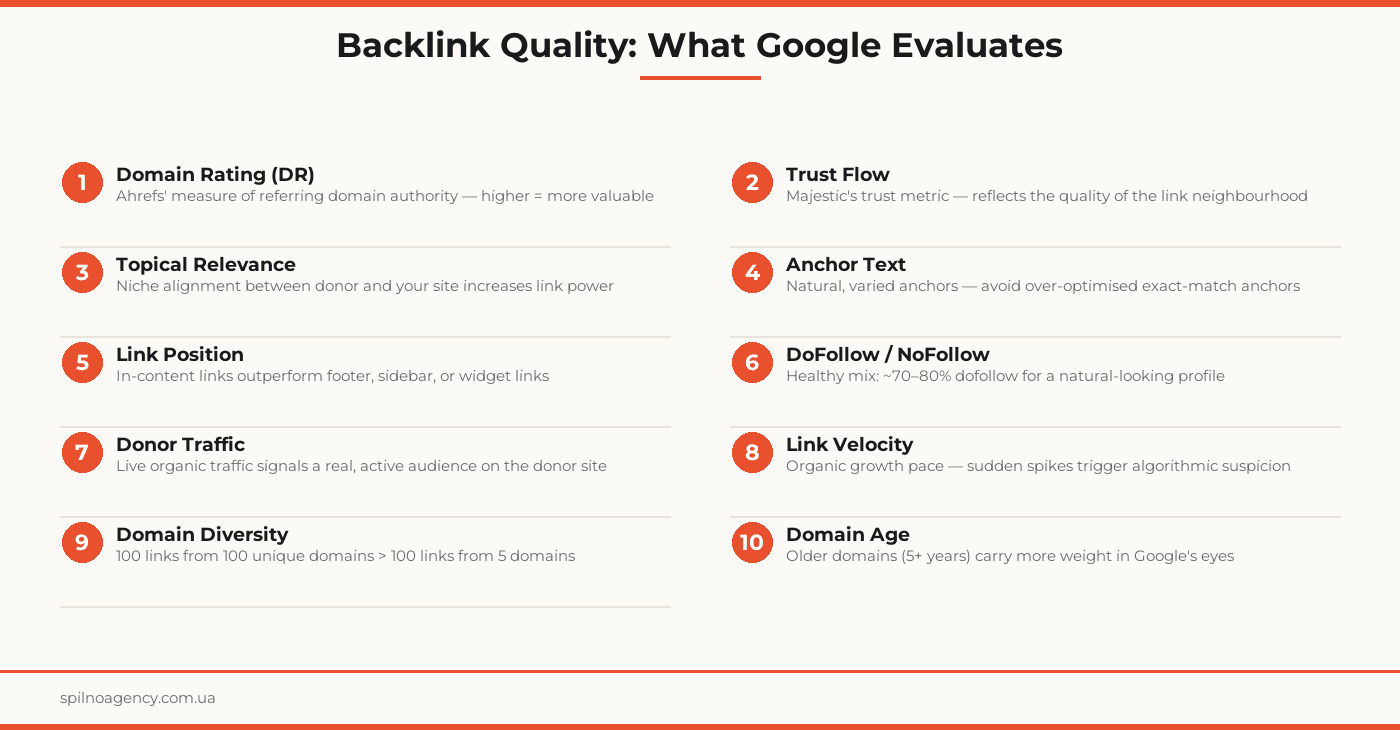
Not all backlinks are created equal. Toxic backlinks can damage your rankings just as much as quality backlinks can improve them.
Signs of a Quality Backlink
- Referring domain has DR 20+ and genuine organic traffic
- The site’s topic is closely related to your niche
- Link appears within the body content, not in footers or sidebars
- Anchor text is natural and varied
- The referring site is not part of a link scheme or exchange network
- The link appears contextually relevant within the article
Signs of a Toxic Backlink
- Donor site operates in “bad neighbourhoods”: gambling, pharma, adult content
- Sitewide links spread across thousands of pages on a single domain
- Very low DR (0–5) with no meaningful traffic
- Heavily over-optimised exact-match anchor text at scale
- Auto-generated, thin content with no editorial value
- Domains registered solely for selling links (link farms)
Audit your backlink profile using Google Search Console → Links and Ahrefs Backlink Checker. Disavow toxic links via Google’s Disavow Tool.
Link Building Strategy: Step by Step
- Audit your current profile — assess backlink count, DR distribution, traffic, and toxic link exposure via Ahrefs or Semrush
- Analyse competitors — identify where top-ranking competitors get their links and find replicable opportunities
- Define target pages — focus your efforts on 5–10 priority pages rather than building links randomly
- Select your methods — based on budget and niche: Guest Posting, Crowd Links, Niche Edits, Marketplaces
- Build your donor list — use Ahrefs Site Explorer, Collaborator, and Referr.com.ua to identify suitable referring domains
- Run your outreach campaign — personalised emails or LinkedIn messages with a clear value proposition
- Monitor weekly — track new and lost backlinks via Ahrefs or Google Search Console
- Scale what works — double down on effective channels; replace underperforming ones
Link Building Tools
- Ahrefs — the most comprehensive backlink database, competitor research, donor discovery, and profile monitoring
- Semrush — backlink gap analysis, outreach module, and Link Building Tool
- Majestic — Trust Flow and Citation Flow for donor quality assessment
- Moz Link Explorer — Domain Authority, Spam Score
- Serpstat — backlink and competitor analysis with Eastern European market coverage
- Google Search Console — free backlink monitoring for your site
- Hunter.io — email discovery for outreach campaigns
- Pitchbox / BuzzStream — outreach automation with personalization at scale
Link Building Checklist
- Backlink profile audit completed (Ahrefs, GSC)
- Toxic links disavowed via Google Disavow Tool
- Priority pages for link building defined
- Competitor backlink profiles researched
- 2–3 primary link acquisition methods selected
- Prospective donor list compiled (min. 50 sites)
- High-quality content prepared for Guest Posting / Niche Edits
- Outreach campaign launched (email / LinkedIn)
- Placements on Collaborator and/or Referr.com.ua with topical donors
- Anchor text varied: branded, keyword, URL, and generic anchors
- New and lost backlinks tracked weekly
- Link profile includes diversity across domain types and link types
Frequently Asked Questions
What is link building in simple terms?
Link building is getting other websites to link to yours. When authoritative, relevant sites link to your pages, Google interprets it as a vote of trust — and ranks you higher. It’s one of the three pillars of SEO, alongside technical optimization and content quality.
How long does link building take to show results?
First ranking movements typically appear 4–12 weeks after acquiring quality backlinks. Full stabilization takes 3–6 months. Timeline depends on niche competition, donor authority, and link volume. Link building is a long-term strategy, not a one-month fix.
What are the best link building tools?
The top tools: Ahrefs (backlink analysis, competitor research), Semrush (link gap analysis), Majestic (Trust Flow, Citation Flow), Moz (Domain Authority), Serpstat (keyword + backlink data). For outreach automation: Pitchbox, BuzzStream, Hunter.io.
Is link exchange safe for SEO?
Direct reciprocal exchanges (A→B, B→A) are in Google’s risk zone — detectable and often devalued. Safer alternatives: triangular exchanges (A→B, C→A, B→C) or topically relevant placements. Keep exchange links under 5–10% of your total profile.
Quality backlinks vs. cheap mass links — which is better?
Quality always wins. Ten links from DR 50+ topically relevant sites outperform 500 links from low-quality directories or spam sites. Mass cheap links risk triggering the Penguin algorithm or a manual Google penalty.
Spilno Agency
Need a link building strategy for your website? Spilno Agency audits your backlink profile, builds a custom strategy, and delivers white-hat and grey-hat link building — safe, measured, and results-driven.

Read also
How to Control an SEO Specialist: The 5-Stage SEO KPI Funnel
SEO KPIs form a chain of five metrics that show, step by step, whether your SEO is actually…
Best CMS for an Online Store: Cloud vs Self-Hosted Platforms in 2026
Compare Shopify, WooCommerce, PrestaShop, OpenCart and Magento for your online store. Pros, cons, and a step-by-step CMS selection…
LinkedIn Ads Library: How to Find Your Competitors’ LinkedIn Ads (2026 Guide)
How to use the LinkedIn Ads Library to see any competitor's sponsored content for free — step by…