Bing Webmaster Tools Launches AI Performance: Citations, Citation Score and Grounding Queries Explained

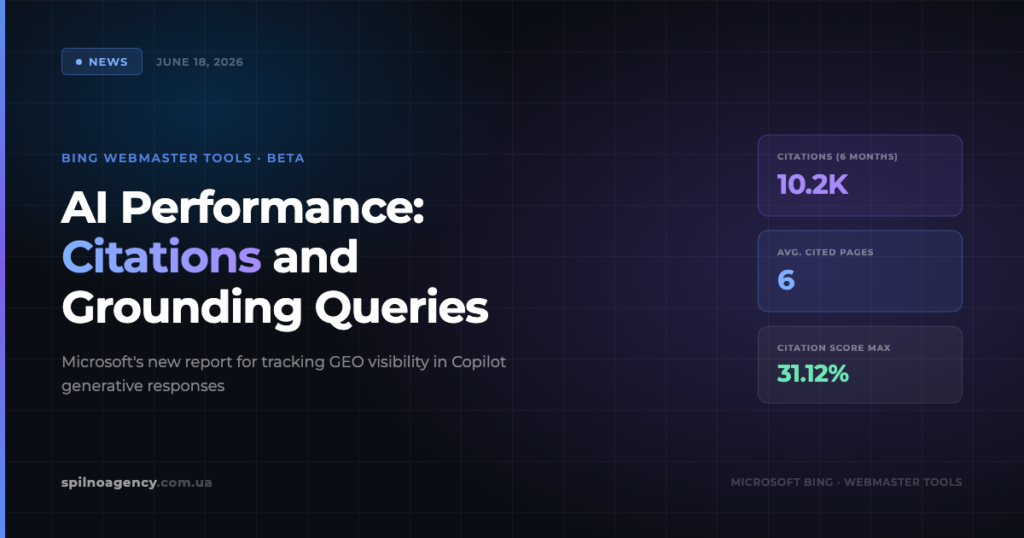
Bing Webmaster Tools has launched an updated AI Performance section — website owners can now see how often Microsoft Copilot and partner AI systems cite their pages, which queries trigger those citations, and what share of AI responses include their content. This is the first Microsoft tool for tracking GEO visibility in generative responses.
What Is AI Performance in Bing Webmaster Tools
Bing Webmaster Tools has added a new section to the main menu — AI Performance (currently in BETA status). It shows how frequently your website appears in responses generated by Microsoft Copilot and other Microsoft AI products when users ask questions related to your content.
If SEO tracks visibility in traditional search results, AI Performance is its equivalent for generative responses — like Google Search Console, but for AI assistants. The report answers the question: “How many times did AI cite my site to back up its answer?”
Data covers citation sources: Microsoft Copilots and Partners — Copilot in Bing, Copilot in Microsoft 365, Copilot in Edge, and partner AI solutions using the Bing Grounding API.
Key Metrics: Citations and Avg. Cited Pages
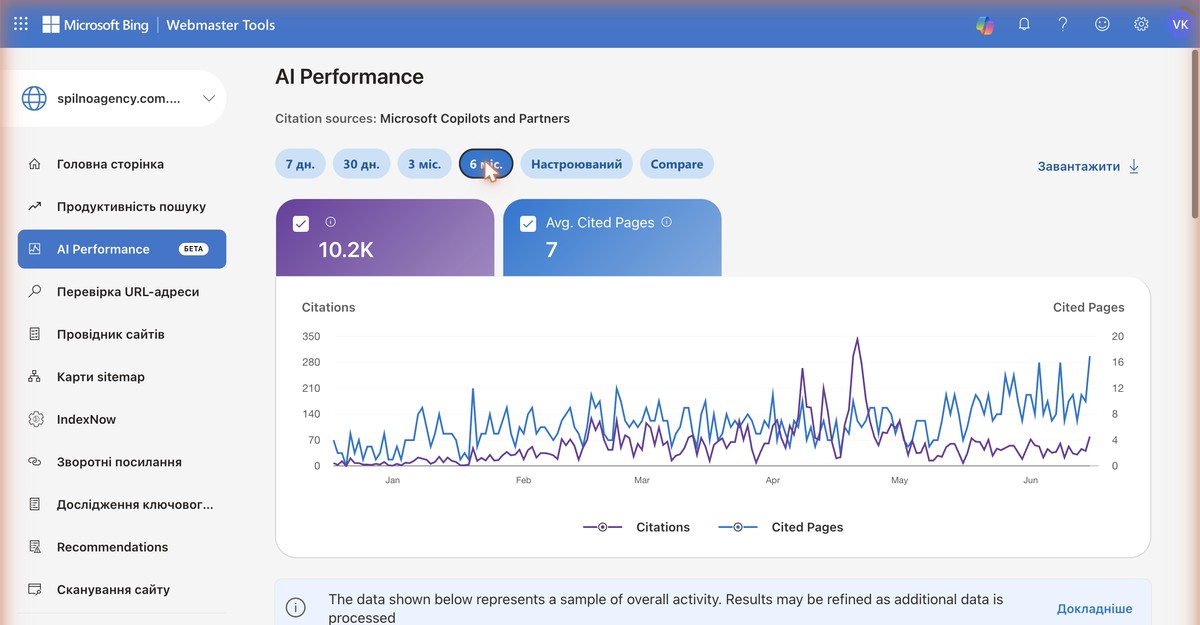
The main AI Performance screen displays two core metrics for the selected period (7 days / 30 days / 3 months / 6 months / Custom):
Citations — total citation count
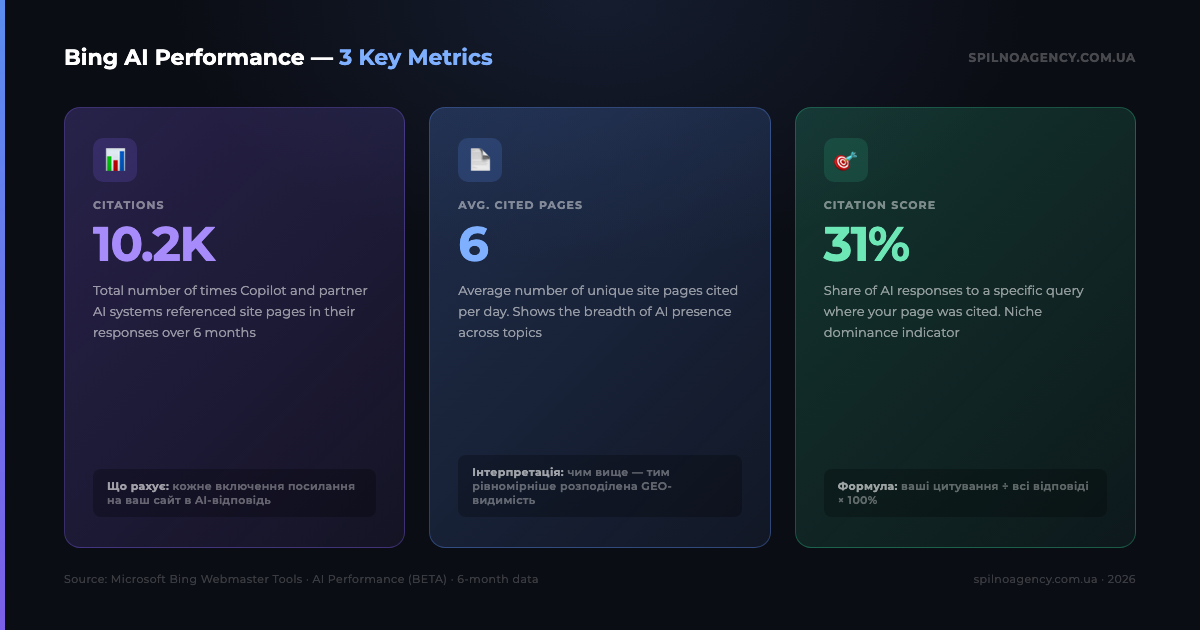
Citations is the total number of times Microsoft AI systems referenced your pages in generated responses. For spilnoagency.com.ua, this figure reached 10,200 citations over six months.
One citation equals one instance of an AI system including a reference or data from your page in a response to a user query. The higher the Citations count, the more frequently Copilot considers your content an authoritative source for grounding its responses.
Avg. Cited Pages — average cited pages per day
Avg. Cited Pages is the average number of unique pages from your site cited per day. A value of 6 means that, on average, 6 different pages from the site appear in AI responses each day.
This metric reveals the breadth of your presence: a low Avg. Cited Pages means AI only cites 1–2 of your top pages; a high value means your content base delivers AI visibility across many topics evenly.
The trend chart
Below the summary cards, a time-series chart displays both metrics simultaneously: Citations (purple line, left axis) and Cited Pages (blue line, right axis). The chart helps you spot seasonality and react to sharp changes: a spike in Citations may indicate a viral piece of content, while a drop could signal a technical issue or a Copilot algorithm update.
Grounding Queries: Which Queries Trigger Copilot to Cite Your Site
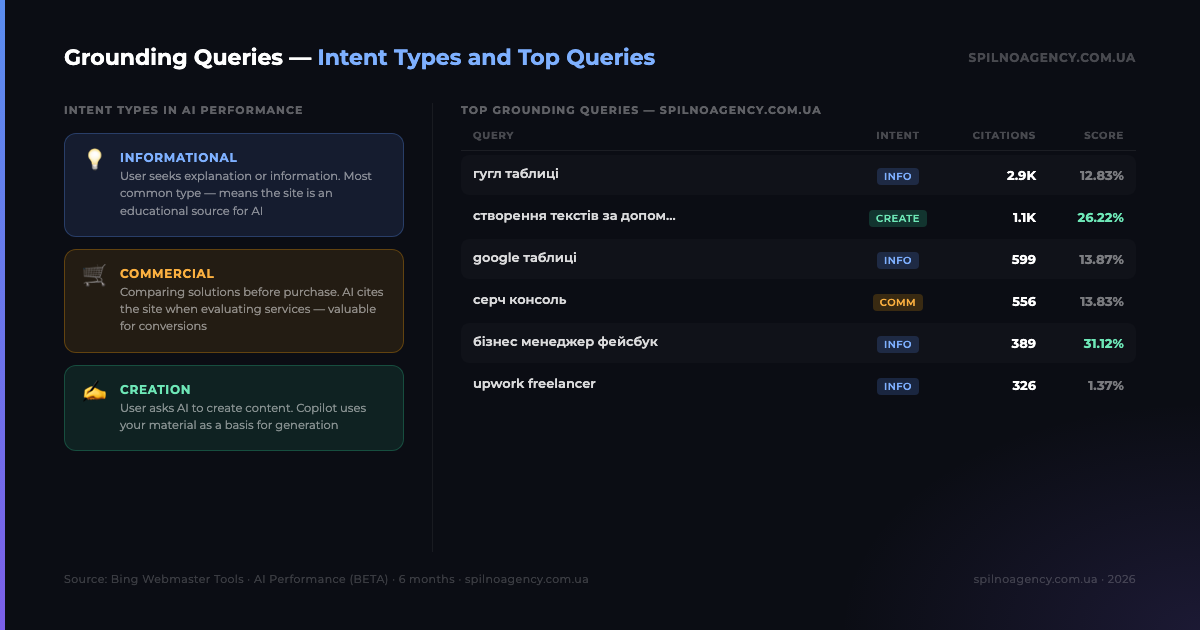
The most valuable part of the report is the Grounding Queries table — a list of specific user queries during which AI cited your site in its responses.
Each query row shows four fields:
- Grounding Query — the query itself (what the user typed into Copilot or Bing AI).
- Intent — intent classification:
Informational(seeking an explanation),Commercial(comparing options before a purchase),Creation(asking AI to generate content). - Topic — thematic category (Business, AI Tools & Platforms, Social Networks & Forums, Freelancing, etc.).
- Citations — how many times your page was cited for this query.
- Citation Score — the share of all AI responses to this query that included a citation from your site (as a percentage).
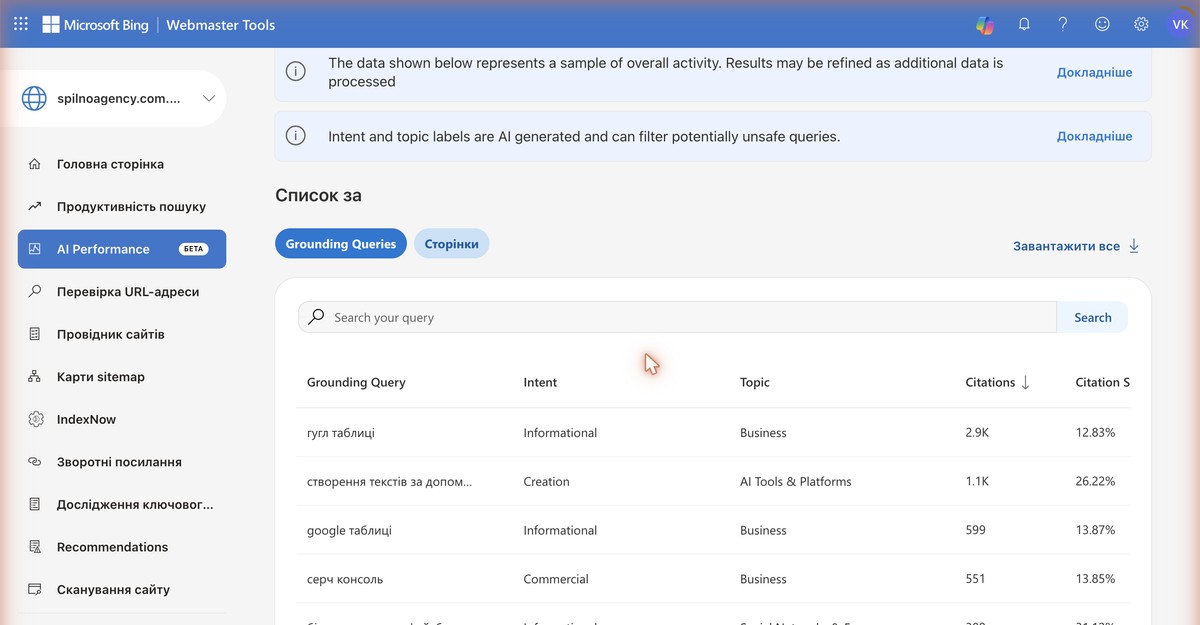
Looking at the table for spilnoagency.com.ua, the query “гугл таблиці” (Google Sheets) generates the most citations — 2,900. However, its Citation Score is 12.83%. In contrast, “бізнес менеджер фейсбук” (Facebook Business Manager) yielded only 389 citations but the highest Citation Score at 31.12% — meaning nearly every third Copilot response to that query cited the site as a source.
Citation Score: How to Read the Share Metric
Citation Score is the most important qualitative metric in the report. It answers: “Of all Copilot responses to this query, in what share did your site appear as a source?”
High Citations with a low Citation Score means the query is highly popular and competitive — your site is cited, but so are many other sources. Few Citations with a high Citation Score signals a niche where you are the dominant source for AI.
Practical takeaway: if Citation Score for a topic is already above 20–25%, your content aligns well with AI grounding needs for that query. Below 5% — there is room to improve the depth and structure of your article.
Technical Notes and Report Limitations
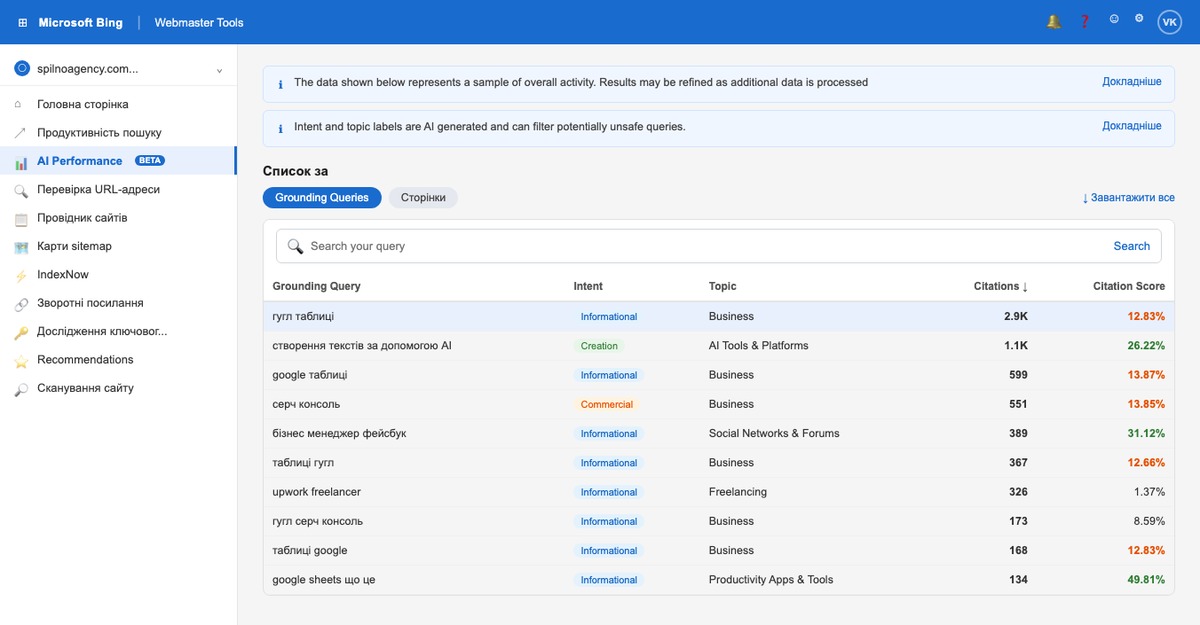
Bing Webmaster Tools itself highlights two important limitations shown in the interface:
- Data is a sample (“The data shown below represents a sample of overall activity. Results may be refined as additional data is processed”) — the figures are a representative sample, not 100% of all citations. Actual citation counts may be higher.
- Intent and Topic are AI-generated labels (“Intent and topic labels are AI generated and can filter potentially unsafe queries”) — query categories are assigned automatically by AI and may filter out potentially unsafe queries. Some topics may be hidden or misclassified.
These limitations don’t invalidate the report, but they matter when making strategic decisions: the numbers reflect trends and relative distribution rather than absolute precise values.
How to Use AI Performance for Your GEO Strategy
Generative Engine Optimization (GEO) means optimising content for generative AI systems rather than traditional search. AI Performance provides concrete data for this strategy:
1. Identify your top-cited pages
Switch to the Pages tab (next to Grounding Queries) — it will show which specific URLs on your site appear most often in AI responses. These pages already have strong GEO positions: update them as a priority to maintain your lead.
2. Find queries with high Citation Score
Queries with a Citation Score above 20% are your “GEO niches” — topics where AI treats you as an authority. Expand content around these themes: add subtopics, FAQ sections, deeper breakdowns — to reinforce your position.
3. Analyse Intent and Topic
If most of your Grounding Queries carry Informational intent — your site is perceived as an educational source. Commercial intent means AI cites you when comparing solutions, which is especially valuable for conversions. Creation intent indicates Copilot uses your content as a basis for generating new text.
4. Track dynamics after publishing
Use the Compare feature (two time-period comparison) to see how new publications affected AI visibility. If Citations for a specific query spike sharply after a new article goes live — the content has entered Copilot’s grounding index or improved its Bing ranking as a source.
FAQ
What is AI Performance in Bing Webmaster Tools?
AI Performance is a section of Bing Webmaster Tools (BETA) that shows how frequently Microsoft Copilot and partner AI systems cite pages from your website in their responses. The report includes total Citations, Avg. Cited Pages per day, and a detailed breakdown by Grounding Queries with Citation Score.
What is a Grounding Query?
A Grounding Query is a specific user query during which the AI system referenced your site in its response. For example, if Copilot answered a question about “Google Sheets” and included information from your article — that query appears in the Grounding Queries table. Analysing these queries reveals which topics AI considers you an authority on.
What does Citation Score mean?
Citation Score is the percentage of AI responses to a specific query in which your site was cited. For example, a Citation Score of 31% for “Facebook Business Manager” means roughly every third Copilot response to that query cited your site as a source. The higher the Citation Score, the more AI trusts your content on that topic.
How does AI Performance differ from Google Search Console?
Google Search Console tracks visibility in traditional search results (clicks, impressions, CTR, position). AI Performance tracks visibility in Microsoft Copilot’s generative AI responses. These are two distinct channels: classic search and AI assistants. Monitoring both gives a complete picture of your brand’s GEO position.
Do Bing Citations affect Google rankings?
There is no direct impact — these are separate systems. However, an indirect effect exists: content that AI systems frequently cite tends to be in-depth, well-structured, and authoritative — exactly the kind of content that also ranks better on Google. Optimising for GEO (deeper content, clear answers, structured FAQ) benefits both channels simultaneously.

Read also
OpenAI Is Changing How Daily Budgets Work in ChatGPT Ads: What Advertisers Need to Know
OpenAI is changing daily budgets in ChatGPT Ads from a hard cap to a 7-day rolling average, with…
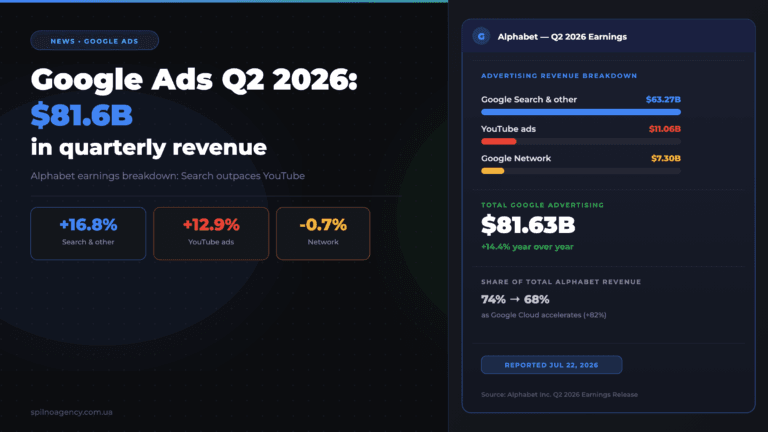
Google Ads Q2 2026 Revenue: $81.6B, Search Outpaces YouTube
On July 22, 2026, Alphabet published its Q2 2026 financial results: Google advertising revenue (Search, YouTube, Network) grew…
New Features in the ChatGPT Ads Dashboard: What Changed in 2026
OpenAI updated the ChatGPT Ads dashboard: conversion-optimized campaigns, new daily budgets, geo exclusions, AppsFlyer/Adjust, bulk API and price/rating…