Google Ads Q2 2026 Revenue: $81.6B, Search Outpaces YouTube

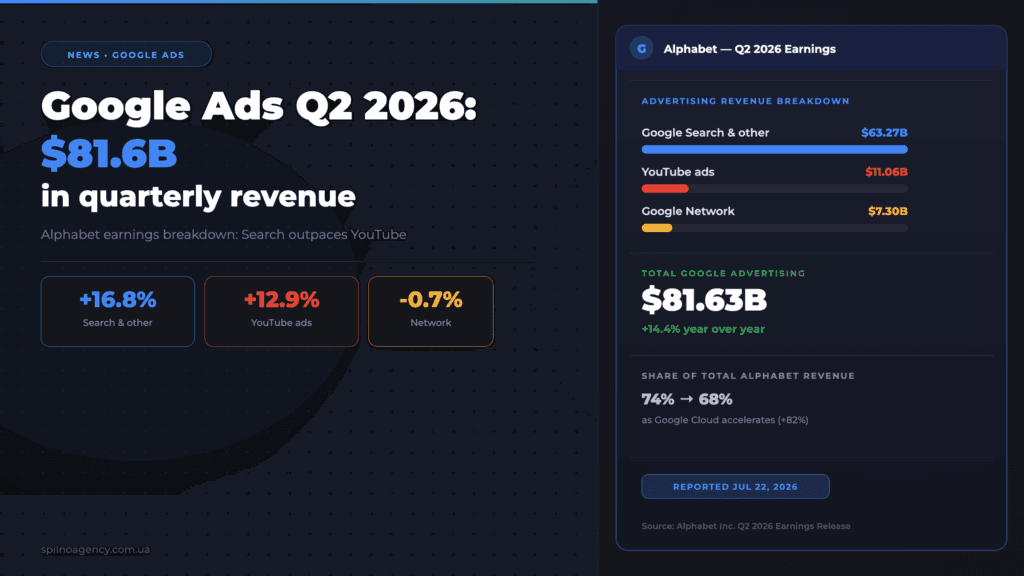
On July 22, 2026, Alphabet published its Q2 2026 financial results: Google advertising revenue (Search, YouTube, Network) grew 14.4% year over year to $81.6 billion. Search posted the fastest growth (+16.8%), YouTube grew 12.9% on the back of the FIFA World Cup, while Google’s third-party ad network (Network) slipped into negative territory (-0.7%) for the first time in several quarters. Here’s what it means for businesses advertising on Google.
How much Google made on advertising in Q2 2026
Alphabet, Google’s parent company, reported results for the quarter ended June 30, 2026. Total company revenue grew 24% to $119.8 billion, and the Google advertising segment (Search, YouTube, and the third-party network combined) brought in $81.6 billion, up 14.4% year over year.
That’s a meaningful signal for the market: despite the wider rollout of AI Overviews and fears that AI would cannibalize clicks and ad impressions, search advertising revenue didn’t just hold up — it grew faster than any other Google advertising line.
Google Ads revenue breakdown by segment
Google discloses ad revenue across three lines. Here’s how each changed year over year (Q2 2025 → Q2 2026):
| Revenue source | Q2 2025 | Q2 2026 | Change |
|---|---|---|---|
| Google Search & other | $54.19B | $63.27B | +16.8% |
| YouTube ads | $9.80B | $11.06B | +12.9% |
| Google Network | $7.35B | $7.30B | -0.7% |
| Google advertising (total) | $71.34B | $81.63B | +14.4% |
Source: Alphabet Inc.’s official Q2 2026 Earnings Release (July 22, 2026).
Google Search & other: the main growth driver (+16.8%)
Search advertising is Google’s largest and fastest-growing line: $63.27 billion for the quarter versus $54.19 billion a year earlier — the highest Search growth rate in several years.
In his earnings commentary, Google and Alphabet CEO Sundar Pichai tied this directly to AI: “our popular AI features are driving Search query growth.” In other words, AI Overviews and other AI features in Search aren’t reducing the number of user queries — they’re increasing them, as people turn to Google more often for longer, more complex questions.
For advertisers, the takeaway is simple: if your Google Ads strategy is still built around fear of AI Overviews, it’s time to rethink it. Search auction volume isn’t shrinking — it’s growing, so the real question isn’t “should we still advertise in Search,” but “how do we adapt campaign structure and content to the new search results page.”
YouTube Ads: the FIFA World Cup 2026 effect
YouTube ads grew 12.9% to $11.06 billion. The growth rate is slightly below Search, but the double-digit gain is notable in its own right: Alphabet’s report specifically calls out that over 1.7 billion unique viewers watched FIFA World Cup 2026-related content on YouTube.
This confirms a familiar pattern: major sporting and cultural events drive short-lived but powerful spikes in attention on YouTube, and advertisers who plan campaigns around the seasonality of such events gain a significant edge in reach at a favorable CPM.
Google Network keeps declining — and it’s now a trend
The most notable negative in the report is Google Network — the third-party site and app network monetized through AdSense and AdMob: $7.30 billion versus $7.35 billion a year earlier, a decline of 0.7%.
This isn’t a one-off dip but the continuation of a multi-quarter trend: Google is systematically shifting ad demand toward its own surfaces — Search and YouTube — where it has more control over inventory quality and monetizes more effectively. For third-party publishers relying on Google’s network, this is a signal to diversify monetization sources.
For advertisers, the practical conclusion is: if a meaningful share of your Google Ads media plan still goes to Display/Network placements, it’s worth regularly benchmarking their performance against Performance Max and pure Search campaigns — demand within Google’s ecosystem is clearly shifting away from the network.
Advertising’s share of Alphabet’s revenue is shrinking — but that’s not weakness
Another notable point: despite growing in absolute terms, advertising’s share of Alphabet’s total revenue fell from 74% in Q2 2025 to 68% in Q2 2026. The reason isn’t that advertising is weakening — it’s that Google Cloud is growing four times faster (+82% year over year, to $24.8 billion) on the back of AI infrastructure demand.
In other words, Alphabet is structurally diversifying toward enterprise AI, but advertising remains the company’s core profit engine: the Google Services segment’s operating margin rose from 40.1% to 41.8% year over year.
What this means for businesses advertising on Google
- The Search auction is growing — competition for positions and keywords will likely intensify in step with Google’s ad revenue growth, so factor this into CPC forecasts for upcoming quarters
- AI Overviews isn’t killing Search ads — Google’s own numbers refute the idea that AI features are collapsing search traffic; instead, query volume and complexity are increasing
- Plan YouTube around seasonal peaks — major events (sports, cultural moments) let you achieve unusually high reach for the same budget
- Display/Network is losing weight — budgets allocated to Google’s third-party network should be regularly reassessed in favor of Search and Performance Max
- Google’s monetization efficiency is improving — traffic acquisition costs (TAC) grew slower (+10%) than ad revenue (+14.4%), suggesting further auction algorithm iterations aimed at raising yield per impression
Frequently asked questions
How much did Google make on advertising in Q2 2026?
$81.63 billion — the combined revenue from Google Search & other, YouTube ads, and Google Network for the quarter ended June 30, 2026. That’s up 14.4% from the same quarter in 2025.
Is AI Overviews hurting Google’s search advertising revenue?
According to Alphabet’s official numbers — no, at least not so far. Google Search & other revenue grew 16.8% year over year, the fastest growth rate among all of Google’s advertising lines. The company attributes this to AI features driving increased search query volume.
Why did Google Network revenue decline?
Google Network (ads on third-party sites and apps via AdSense/AdMob) fell 0.7% year over year. This continues a trend seen over the past several quarters: Google is shifting ad demand toward its own surfaces — Search and YouTube — where monetization and quality control are stronger.
Does Google Cloud’s growth mean Google advertising is becoming less important?
No. Advertising revenue is still growing (+14.4% year over year); it’s just that Google Cloud is growing faster (+82%), so advertising’s share of total revenue is shrinking, from 74% to 68%. Advertising remains Alphabet’s core profit driver, and its margin actually improved.
Where can I find Alphabet’s official Q2 2026 earnings report?
Alphabet Inc.’s full Q2 2026 press release and financial statements are available on the company’s investor relations site at abc.xyz/investor.

Read also

OpenAI Is Changing How Daily Budgets Work in ChatGPT Ads: What Advertisers Need to Know
OpenAI is changing daily budgets in ChatGPT Ads from a hard cap to a 7-day rolling average, with…

New Features in the ChatGPT Ads Dashboard: What Changed in 2026
OpenAI updated the ChatGPT Ads dashboard: conversion-optimized campaigns, new daily budgets, geo exclusions, AppsFlyer/Adjust, bulk API and price/rating…
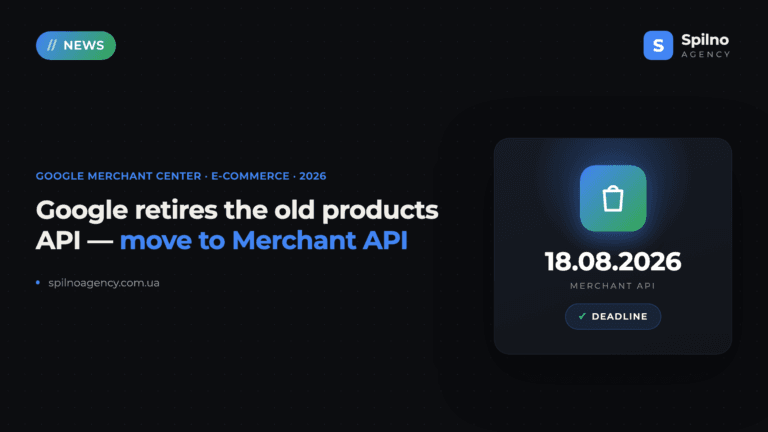
Google Merchant API Changes: Migrate or Request an Extension by August 18, 2026
On August 18, 2026 Google sunsets the Content API for Shopping — migrate to the Merchant API or…