B2B Manufacturer Case Study: 129 Leads and 2.09x ROI with Meta Ads

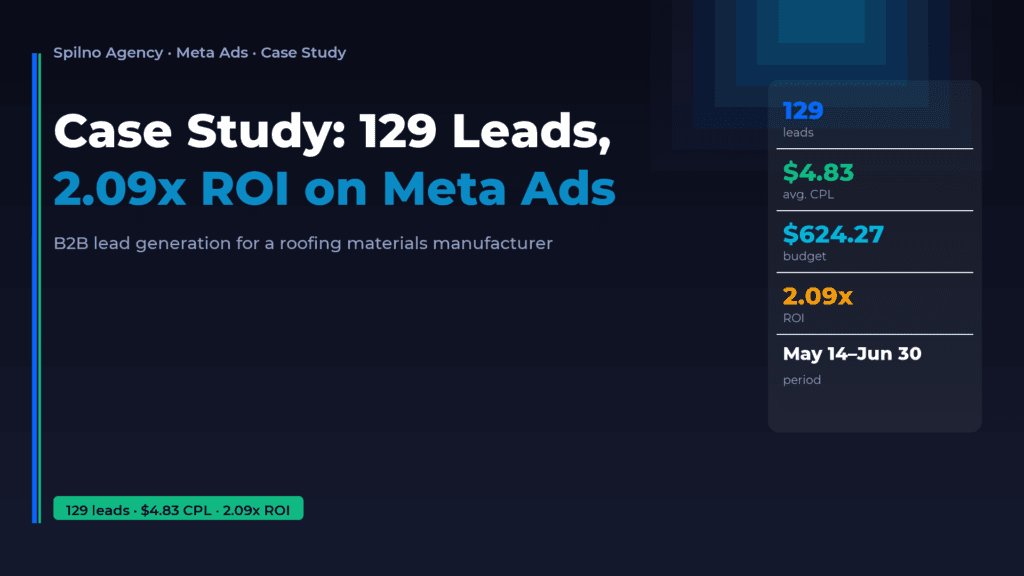
A European roofing and facade materials manufacturer approached Spilno Agency with a clear goal — build a B2B lead generation channel on Meta Ads: requests from businesses, not private buyers, on a scalable ad model. Over 1.5 months (May 14 – June 30, 2026) we generated 129 leads on a $624.27 budget, $4.83 CPL, with a financial result of 2.09x ROI (108.6% ROMI) — a net profit equivalent to roughly $2,150 on roughly $1,970 in ad spend. This case study walks through how we got there, and why “just generating leads” without quality control doesn’t work in B2B.
About the client
The client is a European manufacturer of roofing and facade materials — corrugated sheets and sandwich panels. The company works directly with businesses — construction, installation, and development teams — with no middleman between production and the buyer. We’re deliberately not naming the company or its domain in this case study: the focus here is on the results and the approach, not the brand.
The challenge
The client’s brief was simple on paper: “generate leads specifically from businesses, not private buyers.” Behind that one sentence were several practical problems:
- private-buyer inquiries were cluttering the funnel and pulling the sales team away from real B2B deals;
- there was no proven, scalable advertising model — earlier attempts hadn’t produced a stable flow of requests;
- the account needed to balance lead volume against lead quality, not chase volume alone.
We agreed to work iteratively — test hypotheses, measure results in both leads and revenue, and adjust the strategy based on feedback from the client’s sales department.
Our strategy
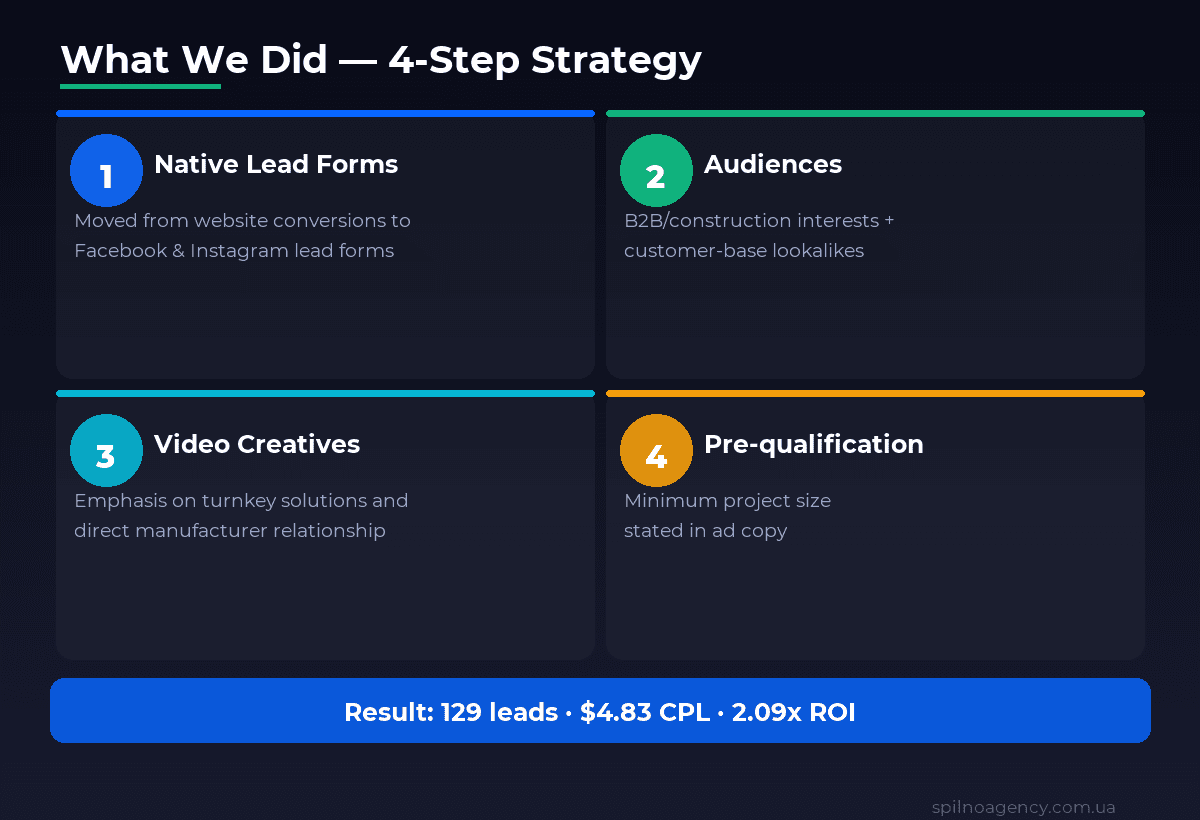
The strategy wasn’t set from day one — each shift was a direct response to data from the previous stage. Four key phases emerged over the course of the project.
1. Foundation: from website forms to native lead forms
The first approach — collecting leads through website conversions — produced too few completed forms: users had to load a page and fill out a form separately from the feed. We switched to native Facebook and Instagram lead forms, removing that extra step so people could submit a request without leaving the app. Lead volume increased immediately on the same budget.
2. Targeting: why website lookalikes fell short
The next test was audiences. Lookalike audiences built from website data underperformed — there simply wasn’t enough website traffic for the algorithm to learn a reliable signal. Interest-based targeting tied to construction, manufacturing, and B2B sectors proved far more effective. In parallel, we tested lookalike audiences built from the company’s existing customer data — and those started delivering promising results.
3. Creative: video over static
Comparing formats, video consistently outperformed static banners. So the strategy shifted priority to video creatives emphasizing practical B2B benefits: turnkey solutions and a direct relationship with the manufacturer, no middleman. That message builds trust — exactly what matters to a B2B buyer making a high-value purchasing decision.
4. Lead quality: pre-qualifying inside the ad itself
As lead volume grew, quality started to slip — small and private-buyer inquiries crept in. The fix: state the minimum project size directly in the ad copy — 300+ m² for corrugated sheets, 200+ m² for sandwich panels. This filtered out non-target prospects before the click, with no extra manual screening burden on the sales team.
Comment from the Spilno Agency specialist

Results
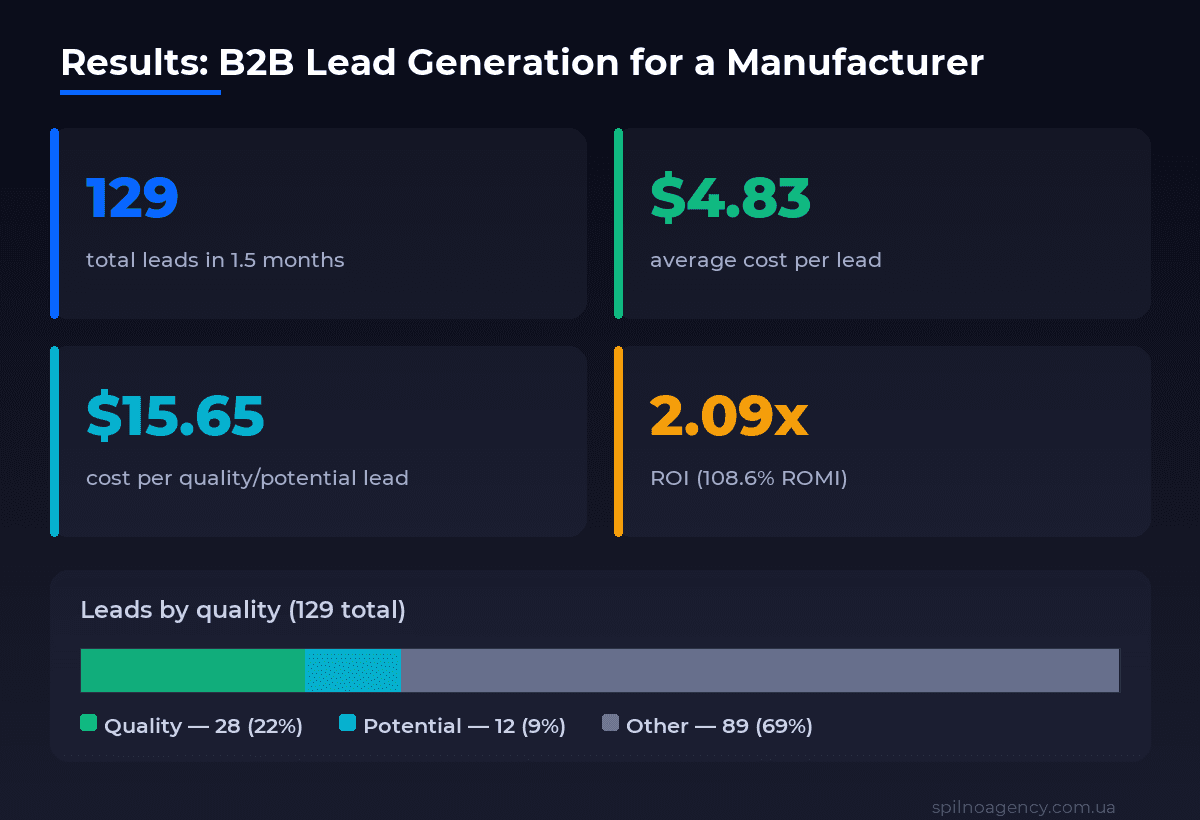
Over the period of May 14 – June 30, 2026 (1.5 months), the campaign delivered the following results:
| Metric | Value |
|---|---|
| Total leads | 129 |
| Ad spend | $624.27 |
| Average cost per lead (CPL) | $4.83 |
| Quality leads | 28 (22.6%) |
| Potential leads | 12 (9.7%) |
| Cost per quality/potential lead | $15.65 |
| Cost per quality lead only | $22.35 |
| Ad investment | 54,730 UAH |
| Revenue generated | 114,183 UAH |
| Net profit | 59,453 UAH |
| ROI / ROMI | 2.09x / 108.6% |
Month-by-month dynamics
The result came from two months of work, and the second month was noticeably stronger than the first — the team had gathered enough data to fine-tune audiences and creatives:
| Month | Ad spend | Revenue | Net profit |
|---|---|---|---|
| May | 19,365 UAH | 37,262 UAH | 17,897 UAH |
| June | 35,365 UAH | 76,921 UAH | 41,556 UAH |
On lead quality and ROI
129 leads is the headline number, but in B2B it means little without a quality breakdown. Of that total, the client’s sales team classified 28 leads (22.6%) as quality and another 12 (9.7%) as potential. The rest were private buyers or requests below the minimum project size. That’s why we tracked not the generic “cost per lead,” but the cost per quality/potential lead — $15.65: a number that actually reflects the channel’s value to the client’s business. The financial result confirmed it: 54,730 UAH in ad investment generated 114,183 UAH in revenue — a 2.09x ROI, or 108.6% ROMI.
One more nuance is worth adding here, since it affects the final numbers: B2B deals close on a longer cycle than retail purchases. A lead doesn’t submit a request and pay an invoice on the spot — first come discussions on volume, price, and delivery timelines, and only then does the deal get signed. That means some of the leads generated in May and June were still in negotiation when these results were calculated, and hadn’t converted into a sale yet. The real profit from this campaign is deferred: it keeps growing in the following months as deals from these “long” leads close. In other words, the channel’s final ROI will end up higher than the 2.09x already recorded here.
Key improvements
- Switched from website forms to native lead forms on Facebook and Instagram — removed friction and increased lead volume.
- Found a targeting model that works — construction- and B2B-related interests, plus customer-base lookalikes instead of website lookalikes.
- Shifted creatives to video emphasizing turnkey solutions and a direct relationship with the manufacturer.
- Built pre-qualification into ad copy — minimum project size filters out non-target audiences before the click.
- Built a managed evaluation system — lead quality, sales feedback, and financial results tracked together, not separately.
Conclusion
This case shows that in B2B lead generation, “more leads” and “a better result” aren’t always the same thing. A managed system that evaluates performance across three criteria at once — lead quality, sales feedback, and financial outcome — lets you scale advertising deliberately instead of chasing volume blind. In 1.5 months, we took the channel to 129 leads, $4.83 CPL, and a 2.09x ROI — and laid a foundation ready for further scaling.
If your B2B business wants leads from actual companies rather than private buyers, and wants to scale advertising without losing lead quality — get in touch, and we’ll audit your ad account and map out a plan for building a B2B funnel on Meta Ads.
FAQ — B2B lead generation on Meta Ads
How much does a B2B lead cost on Meta Ads for a manufacturer?
In this case, average CPL was $4.83 on a $624.27 budget. Counting only quality and potential leads, cost rises to $15.65. B2B manufacturing CPL is always higher than e-commerce, since the sales cycle is longer and average deal size is larger.
Why do native Facebook and Instagram lead forms outperform a website contact form for B2B?
Website conversions required an extra step — loading a page and filling a separate form. Native lead forms remove that step: people submit a request without leaving the app, directly increasing form completions.
How do you target a B2B audience on Meta Ads when website data is limited?
Website lookalikes underperformed due to thin traffic. Interest-based targeting (construction, manufacturing, B2B) and lookalikes built from existing customer data became the more reliable signal.
Why do video creatives outperform static banners in B2B advertising?
Video consistently outperformed static banners and gave more room to show production scale and the benefits of working directly with the manufacturer — building trust for a high-value B2B purchase decision.
How do you improve B2B lead quality without losing lead volume?
Stating the minimum project size directly in the ad copy (e.g. 300+ m² for corrugated sheets) filters out private buyers and small requests before the click — no manual sales-team screening required.


Read also
How Claude Helps Spilno Agency: Google Merchant Coverage in Google Ads
An online store lists 1,375 products in Google Merchant — but how many of them are actually running…
Google Ads for a Local Auto Service: Fewer Impressions, More Customers (Case Study)
A local auto service was spending its ad budget on tens of thousands of cheap impressions that barely…
Case Study: Scaling Sales for a Women’s Footwear Brand with Meta Ads — 276 Purchases, ROAS 5.35
Our client is a mid-range women’s footwear retailer with an offline store network and its own e-commerce shop.…