Google Ads for Freight and Oversized Transportation — Case Study

A freight and oversized transportation company came to us with a CPL of 443 UAH and just 50 leads per month from their previous agency. In 4 months of work, we cut the cost per lead to 226 UAH (−49%) and reached 152 enquiries in November. Here is the full breakdown: audit, restructuring, Search + PMax campaigns, and how we handled a complete account suspension.
Business Challenge
The client is a European-facing transport company with two core service lines: international freight transportation and oversized cargo shipping. They came to us after terminating their previous agency due to unsatisfactory advertising results.
On paper, leads were being generated. But the conversion rate from lead to paying client — and the actual revenue — did not justify the ad spend. There was zero transparency in reporting: the previous agency tracked cost per lead only, with no visibility on clients acquired or revenue generated.
Starting Point (Before Spilno)
- Cost per lead: 443 UAH incl. VAT
- Monthly leads: 50
- Reporting transparency: none
- Conversion tracking: misconfigured
Audit: What We Found Before Launch
Before launching any new campaigns, we conducted a full audit of the Google Ads account and analytics setup. Without this step, any optimisation would be built on flawed data.
- Audited GA4 conversion tracking — found duplicate goals and incorrect triggers. Without accurate conversion tracking, the algorithm optimises towards false signals.
- Set up call tracking — phone calls were the primary lead source in this niche but were not being recorded as conversions.
- Analysed the previous agency’s campaigns: identified which keywords produced leads and which consumed budget without results.
- Introduced full-funnel reporting: cost per lead, cost per client acquired, and revenue attribution — giving the client genuine ROAS visibility.
What We Did to Drive Results
Following the audit, we built a restructuring plan and launched new campaigns with a clear performance framework.
1. Account Restructuring
The previous structure mixed all service lines into shared campaigns. We separated budget and strategy by service:
- Dedicated campaign — international freight
- Dedicated campaign — oversized cargo
- Separate spend tracking, leads, and CPL per direction
2. Launching Search + Performance Max Campaigns
For each service direction, we ran two campaign types:
- Search — high-intent commercial queries: “freight transport quote”, “oversized shipping price”, “international cargo delivery”
- Performance Max — scaling across all Google channels (Search, Display, YouTube, Gmail, Maps) with conversion-based bidding
3. Audience Signals and Remarketing
We built remarketing audiences for site visitors who did not submit an enquiry. For the B2B segment (corporate logistics buyers), we applied custom audience signals within Performance Max campaigns.
Month-by-Month Performance
Below are the real figures from the advertising account for each month. A lead is defined as a phone call or contact form submission from the website.
| Month | Leads | CPL (incl. VAT) | Note |
|---|---|---|---|
| Before Spilno | 50 | 443 UAH | Previous agency benchmark |
| August | 103 | 230 UAH | Campaign launch |
| September | 85 | 294 UAH | |
| October | 105 | 320 UAH | |
| November | 152 | 226 UAH | Best performing month |
| December | 43 | 257 UAH | Only 12 days active — account suspended |
| January | 63 | 254 UAH | Active from 12 January post-reinstatement |
| February | 91 | 279 UAH |
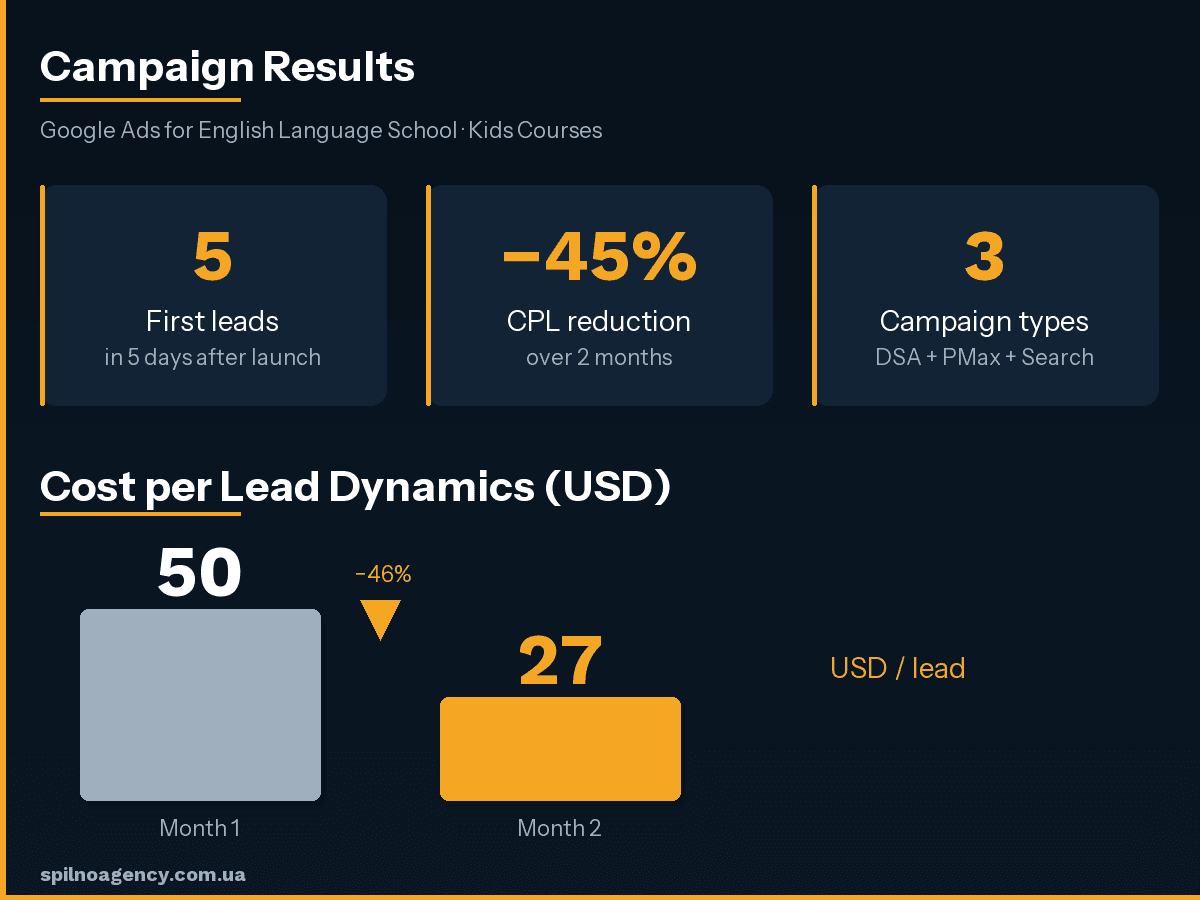
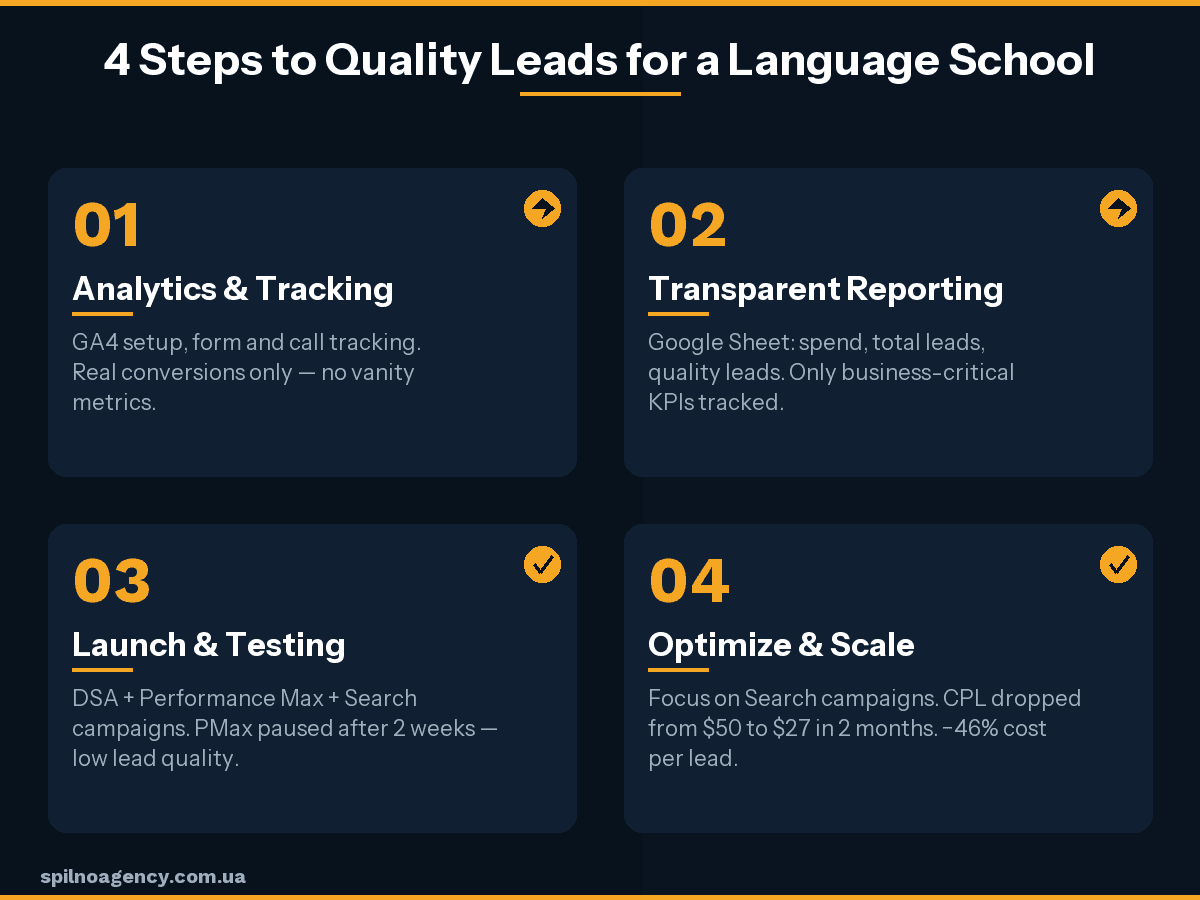
The cost per lead dropped almost in half — from 443 UAH to 226–230 UAH. Lead volume grew 2–3× with the same or lower ad spend.
Challenge: Google Ads Account Suspension
In December, the Google Ads account was suspended. We were active for just 12 days that month — hence the low lead volume (43 at a CPL of 257 UAH).
The reinstatement process took exactly one month. In parallel, we prepared all documentation for the appeal and worked to minimise losses for the client. From 12 January, operations resumed at full capacity.
The key takeaway: even after a full suspension and return to the ad auction, we recovered performance quickly — February CPL was 279 UAH, still 1.6× below the original benchmark.
Results Summary
- CPL dropped from 443 UAH to 226 UAH at peak (−49%)
- Monthly leads grew from 50 to 152 in November (+204%)
- Client received full-funnel reporting: CPL, clients acquired, ad-driven revenue
- Successfully navigated account suspension with minimal impact
- Ongoing engagement — performance holding steady
Want the same results for your freight or logistics company? Send us an enquiry for a free consultation.
Request for marketing consultation
Frequently Asked Questions
How much does Google Ads cost for a freight company?
The cost per lead depends on competition, geography, and landing page quality. In our case, we reduced CPL from 443 UAH to 226 UAH (−49%) over 4 months in the international and oversized cargo niches.
Which Google Ads campaign types work best for freight transport?
The most effective combination is Search (high-intent queries) paired with Performance Max (scaling across all Google channels). Search captures direct intent, while PMax optimises conversions across Search, Display, YouTube, Gmail, and Maps.
What should you do if your Google Ads account gets suspended?
Identify the reason, submit an appeal with company documentation, and — if the review takes too long — prepare a backup account in parallel. In our case, reinstatement took one month.
How do you measure advertising effectiveness for a logistics company?
Key metrics: CPL (calls + forms), monthly lead volume, lead-to-client conversion rate, and revenue from advertising. Set up call tracking and form tracking via GA4 and import conversions into Google Ads.
How is promoting international freight different from oversized cargo?
International freight has broader geographic intent and higher average order values. Oversized cargo is a narrower niche with lower competition and higher margins. Separating them into dedicated campaigns enables precise budget control and CPL tracking per service line.

Read also
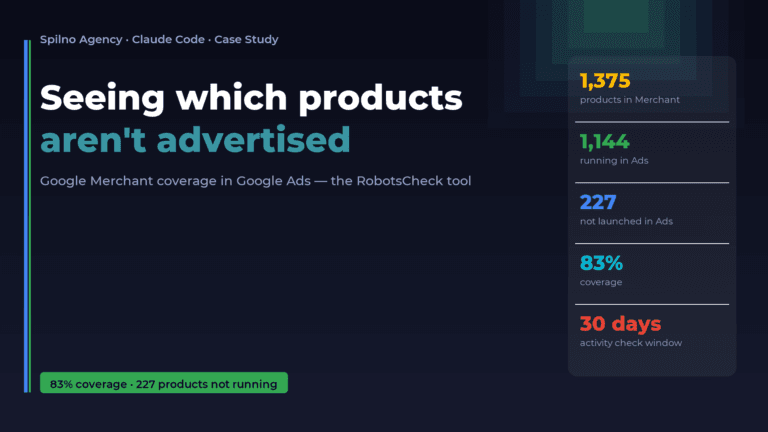
How Claude Helps Spilno Agency: Google Merchant Coverage in Google Ads
An online store lists 1,375 products in Google Merchant — but how many of them are actually running…
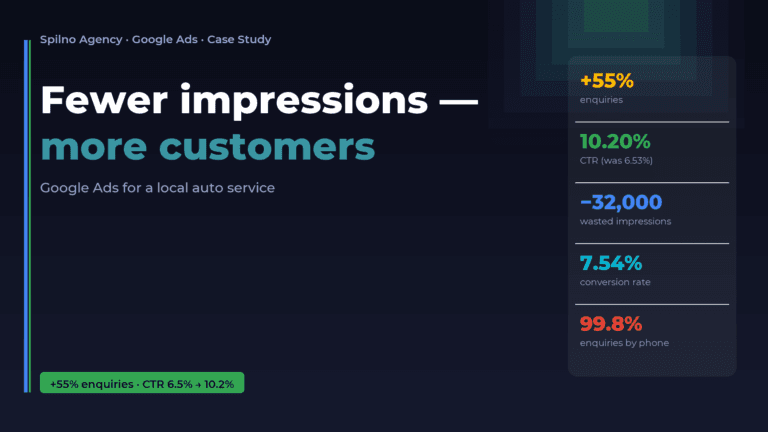
Google Ads for a Local Auto Service: Fewer Impressions, More Customers (Case Study)
A local auto service was spending its ad budget on tens of thousands of cheap impressions that barely…
Google Merchant API Changes: Migrate or Request an Extension by August 18, 2026
On August 18, 2026 Google sunsets the Content API for Shopping — migrate to the Merchant API or…