Main Stages of Website SEO Promotion: Step-by-Step Guide

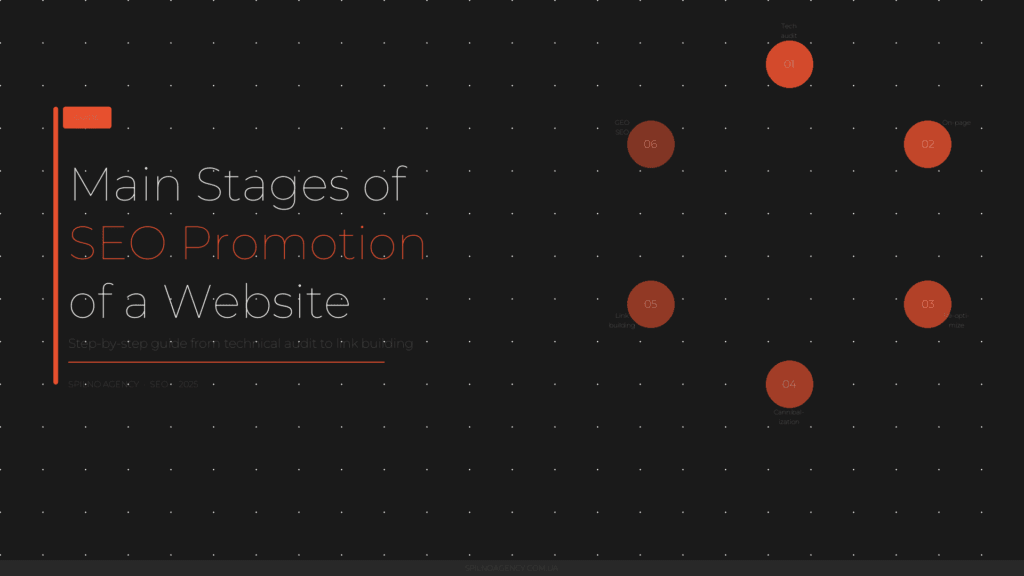
SEO website promotion is a systematic process that turns your site into a stable source of organic traffic. But most business owners hear the word “SEO” and imagine something abstract: “stuffed in some keywords, got some traffic.” In reality, modern search engine optimization consists of 6 interconnected stages, each of which impacts the final result.
In this article we will break down every SEO promotion stage in detail: from technical audit to link building and GEO optimization. Whether you are just starting out or have been promoting your site for years — this guide will help you find weak spots and fix them.
What is SEO website promotion and why does your business need it
In plain terms: SEO is the work that gets your website showing up in Google for the queries your customers type. You pay for the work rather than for each visit, and the results accumulate.
Why this matters to your business: a year in, this channel costs roughly the same but brings several times more people — unlike advertising, where doubling traffic means doubling the budget.
SEO (Search Engine Optimization) is a set of activities aimed at improving a website’s positions in Google and other search engine results. The goal is to attract a target audience organically, without paying for every click.
Unlike paid advertising, SEO traffic does not disappear when you stop your budget. It is a long-term investment: a properly optimized site continues to bring clients months and years after active work is completed.
SEO is not a bag of tricks. It is a strategy that starts with understanding how your customer searches for a solution to their problem.
When you should start SEO promotion:
- When launching a new website — so you don’t spend your advertising budget forever
- When migrating to a new domain or changing your CMS
- When traffic has dropped or rankings have fallen
- When ad campaigns have become too expensive
- When competitors are visible in search and you are not
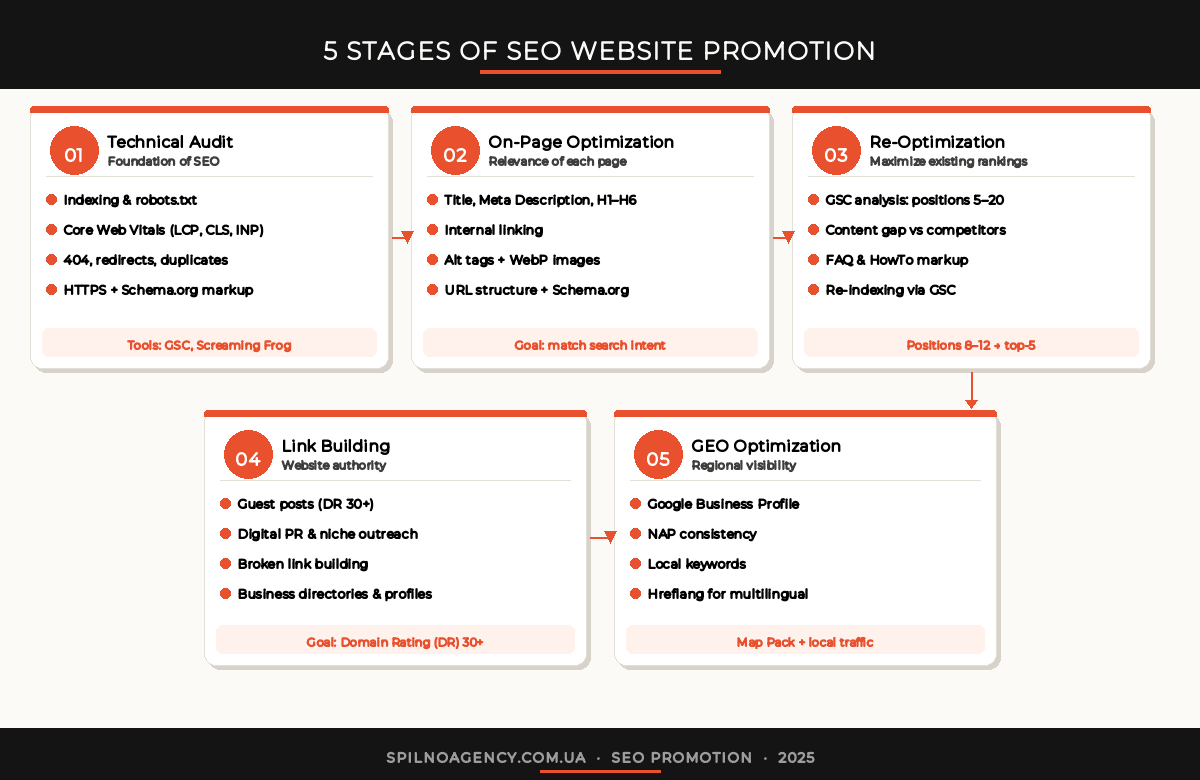
Stage 1. Technical Site Audit
A technical audit checks whether Google can properly read your website at all.
It often goes like this: the pages exist, they are useful and well made, but the search engine never reaches them. A configuration error gets in the way, or slow loading, or dozens of near-identical duplicate pages among which Google cannot tell which one to show.
Why this matters to your business: until this is fixed, any investment in content and links works at half strength or does not work at all.
A technical SEO audit is the foundation of any promotion. Without it, any content optimization or link building will be wasted effort. Search bots must be able to crawl, index, and understand your site structure without obstacles.
What a technical audit checks:
- Indexation and accessibility — whether all important pages are accessible to Googlebot. We check robots.txt, noindex tags, and XML sitemap.
- Loading speed — Core Web Vitals (LCP, CLS, INP). Google directly factors these metrics into ranking. Target: LCP < 2.5 sec, CLS < 0.1.
- Mobile-friendliness — Mobile-First Indexing means Google evaluates your site primarily from a mobile device perspective.
- Technical errors — 404 pages, redirect chains, duplicate content, canonical tags.
- HTTPS and security — presence of an SSL certificate, absence of mixed content.
- Structured markup — Schema.org microdata to improve visibility in rich snippets.
- Hreflang for multilingual sites — correct binding of language versions of pages.
💡 Tip: Start the technical audit with free tools — Google Search Console (indexing errors), PageSpeed Insights (Core Web Vitals). For deeper analysis use Screaming Frog, Sitebulb, or Ahrefs Site Audit.
Technical audit priorities:
- 🔴 Critical: pages blocked in robots.txt, missing SSL, mass 404 errors, duplicates without canonical
- 🟡 Important: slow loading (LCP > 4 sec), missing sitemap, broken internal links
- 🟢 Improvements: Schema.org markup, image compression, lazy load
Stage 2. On-page SEO Optimization
On-page is everything done inside the pages themselves: headings, text, images, the structure of sections.
The goal is simple: a person arriving from search should understand within seconds that they landed in the right place, and find the answer to their question without scrolling to the very bottom.
Why this matters to your business: this is the cheapest stage of SEO and also the one that moves rankings fastest — it needs neither developers nor a link budget.
On-page optimization is the full set of work done directly on the pages of your site. The goal: make each page as relevant as possible for target search queries and user-friendly.
Key elements of on-page optimization:
-
Title and Meta Description
The Title is the most important meta tag. It must contain the primary keyword, be unique and compelling. Length: 50–60 characters.
Meta Description does not directly affect positions but significantly influences CTR (click-through rate). Target: 120–155 characters, with a CTA. -
H1–H6 headings
H1 — one per page, contains the main keyword. H2/H3 — structure the content and contain LSI keywords (semantically related terms). A proper heading hierarchy improves Google’s crawling and readability. -
Text content
Content must match the user’s search intent. Google distinguishes 4 types of intent: informational, navigational, transactional, commercial. Stuffing text with keywords without considering intent is a common mistake. -
Internal Linking
Links between site pages distribute “link juice” and help Google understand the structure and hierarchy of your content. Rule: every important page should receive internal links from relevant materials. -
Image optimization
Alt tags with keywords, file compression (WebP instead of JPEG/PNG), descriptive file names (seo-website-promotion.webp rather than img001.jpg). -
URL structure
Short, readable URL: /seo-website-promotion/ instead of /post?id=1234. Use hyphens instead of underscores.
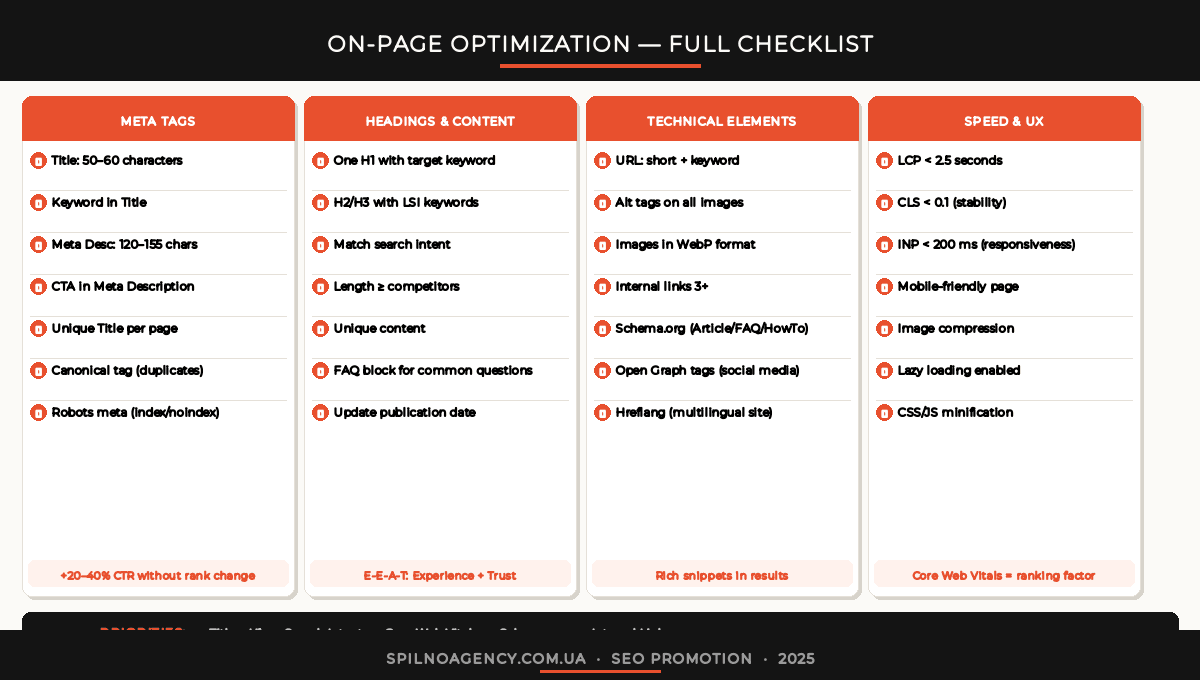
✅ On-page optimization checklist:
- Unique Title with keyword (50–60 characters)
- Compelling Meta Description with CTA (120–155 characters)
- One H1 per page with keyword
- H2/H3 structure with LSI keywords
- Alt tags on all images
- Internal links to related pages
- Readable URL without extra parameters
- Schema.org markup (Article, FAQ, HowTo)
Stage 3. Page Re-optimization
Re-optimization is the repeated optimization of already-indexed pages based on real data from Google Search Console. It is one of the most effective methods for quick traffic growth, because you work with pages that already have some visibility.
Google Search Console shows which queries your page already appears for in search and what its position is. If a page is in positions 5–15 for a valuable query — it is an ideal candidate for re-optimization.
The page re-optimization process:
- Query analysis in GSC — select pages with positions 5–20 for queries with good search volume.
- Top-10 competitor analysis — see what they have that you don’t: text length, subsections, FAQ, images, tables.
- Content supplementation — add sections that close “gaps” relative to competitors. Don’t rewrite — supplement.
- Update Title and H1 — include additional keyword queries the page already ranks for.
- Add structured data — FAQ Schema for frequently asked questions, HowTo for guides.
- Update the date — fresh content ranks higher for many queries.
- Submit URL for re-indexing — via “URL Inspection” in Google Search Console.
💡 Pro tip: Pages in positions 8–12 have the highest growth potential from re-optimization. Moving them into the top 5 is often much easier than promoting new pages.
Stage 4. Off-page Optimization and Link Building
Off-page SEO is all efforts outside of your website that affect its authority in Google’s eyes. The most important off-page SEO tool is link building.
What is link building
Link building is the process of acquiring external links (backlinks) from other websites to yours. Google views links as “votes of trust”: the more authoritative sites that link to you, the higher your Domain Rating (DR) and search positions.
But not all links are equal. One link from an authoritative niche resource (DR 60+) can deliver more impact than 100 links from irrelevant low-quality sites.
Effective link building methods:
-
Guest Posting
Writing articles for niche blogs and publications with a link to your site. The most effective method for acquiring quality links. Look for platforms with DR > 30, relevant topics, and real traffic. -
Digital PR
Publishing research, statistics, case studies that naturally attract links from media and industry sites. The most expensive but most effective method. -
Niche Editorial Link Building
Direct agreements with editors of niche resources to place links in existing articles or new materials. -
Broken Link Building
Finding broken links on niche sites and offering to replace them with your content. High conversion rate because the site owner is interested in fixing the error. -
Business directories and profiles
Registration in Google Business Profile, industry directories, niche platforms. Provides baseline links and improves local SEO. -
Resource pages
Thematic resource pages often link to the best materials in a niche. Find such pages via search:"useful resources" + your topic.
Link quality metrics:
- Domain Rating (DR) — authority of the donor domain (Ahrefs). Target: DR 30+
- Topical relevance — how closely the donor’s topic matches yours
- Donor traffic — real organic traffic (not inflated)
- Link type — dofollow links pass authority; nofollow don’t, but are still useful for link profile
- Anchor text — should be natural, not overloaded with exact keyword queries
💡 Practical tip: Start link building only after completing the technical audit and on-page optimization. Links to a technically “sick” site will have much less effect and may turn out to be wasted resources.
Stage 5. GEO Optimization (Local and Geolocation SEO)
GEO optimization (geolocation SEO) is the adaptation of a site to obtain traffic from specific geographic regions. This is critically important for:
- Local businesses (cafés, beauty salons, dental clinics, shops)
- Regional services (city delivery, apartment renovation in Kyiv)
- Multi-regional companies with different offerings for different cities
- Multilingual sites with audiences in different countries
Key elements of GEO optimization:
-
Google Business Profile (formerly Google My Business)
A mandatory step for any local business. Fill in all fields: address, working hours, photos, categories, responses to reviews. The profile directly affects visibility in “Google Maps” and the local pack (Map Pack in search). -
NAP consistency
Name, Address, Phone — these data must be the same on your website, Google Business Profile, and all online directories. Any discrepancy lowers Google’s trust in local signals. -
Local keywords
Use geolocated queries: “SEO promotion in London”, “SEO agency Manchester”, “website promotion UK”. These queries have lower competition and higher conversion. -
Local content
Pages for specific cities and regions. Not just “SEO in [city]” with a form — but full content about market specifics, project examples, client reviews from the region. -
Local link building
Links from regional media, city portals, local business directories, partner companies from your city. -
Hreflang for multilingual sites
If your site has multiple language versions (uk/en/pl/ru) — correct hreflang implementation is critical. Errors in hreflang lead to Google showing the wrong language version for different countries. -
Schema.org LocalBusiness
Structured markup for local business conveys precise information about your location, business hours, and contacts to Google.
GEO optimization for multi-regional sites:
- Separate landing pages for each city/region
- Unique content for each regional page (do not copy)
- Embedded Google Maps on pages with address
- Reviews tied to specific regions
- Regional internal linking
How long does SEO promotion take
One of the most common questions from clients. The honest answer: first results are visible in 2–4 months, significant traffic growth — in 6–12 months. Competitive niches may require 12–18 months of active work.
Factors affecting the speed of results:
- Domain age — older domains rank faster
- Current site condition — if there are critical technical errors, we fix them first
- Niche competitiveness — in low-competition niches results can appear in 1–3 months
- Link building budget — more quality links = faster growth
- Publishing regularity — fresh content accelerates indexing
Need help with SEO promotion?
The Spilno Agency team is ready to conduct a free technical audit of your site and develop an individual promotion strategy.
👉 Order a free audit right now
Frequently asked questions about SEO promotion (FAQ)
Can you do SEO yourself?
Technically — yes. Basic on-page optimization and writing quality content are accessible without specialized knowledge. But technical audit, link building strategy, and deep semantic optimization require experience and specialized tools. Mistakes in SEO can result in Google penalties.
What is the difference between SEO and paid advertising?
SEO delivers long-term organic traffic without paying for every click. But results come more slowly (3–12 months). Paid advertising delivers instant traffic but stops with the budget. Optimal strategy: launch ads for a quick start + build SEO in parallel for long-term results.
How much does SEO promotion cost?
The cost depends on niche competitiveness, site size, and goals. Monthly SEO service costs vary widely by market and agency. A one-time technical audit typically ranges from a few hundred to several thousand dollars depending on site complexity.
Does ChatGPT-generated content affect SEO?
Google does not penalize AI-generated content by itself. What matters most is quality and usefulness to the user. But generic AI content without unique perspective, experience, and facts (E-E-A-T) ranks worse. For SEO effectiveness, AI content needs refinement: add examples, data, and expert opinion.
In What Order Should You Do the Tasks?
One of the most common questions: where to start and what comes next? Below is a proven sequence that delivers results without “jumping around”:
- Technical Audit — the first and mandatory step. If your site has critical technical issues, no other work will deliver its full potential.
- On-page Optimization — after the technical audit, optimize priority pages: correct Title/H1, content structure, internal linking.
- Page Re-optimization — in parallel with the previous step: expand pages already ranking in the top 20 to reach the top 5.
- Link Building — start once the technical foundation and content are ready. Links to a technically broken site deliver minimal results.
- GEO Optimization — start in parallel with or after link building, if your business has a regional focus.
💡 Important: SEO is not a one-time job — it’s a cycle. After completing all 6 steps, return to step 3 (page re-optimization) and start a new cycle based on fresh data from Google Search Console.
Conclusion: a systematic approach to SEO promotion
SEO website promotion is not a one-time action, but a continuous process of six interconnected stages:
- Technical audit — the foundation for all subsequent work
- On-page optimization — relevance of every page
- Page re-optimization — maximizing existing positions
- Eliminating — focusing signals on priority pages
- Off-page and link building — site authority in search
- GEO optimization — regional visibility and local traffic
The key to success is consistency and patience. Spilno Agency SEO specialists have implemented dozens of projects in Ukraine and abroad. If you want an individual strategy for your project — contact us.

Read also
How to Control an SEO Specialist: The 5-Stage SEO KPI Funnel
SEO KPIs form a chain of five metrics that show, step by step, whether your SEO is actually…
Best CMS for an Online Store: Cloud vs Self-Hosted Platforms in 2026
Compare Shopify, WooCommerce, PrestaShop, OpenCart and Magento for your online store. Pros, cons, and a step-by-step CMS selection…
LinkedIn Ads Library: How to Find Your Competitors’ LinkedIn Ads (2026 Guide)
How to use the LinkedIn Ads Library to see any competitor's sponsored content for free — step by…