SEO Strategy: What It Is and How to Build One Step by Step

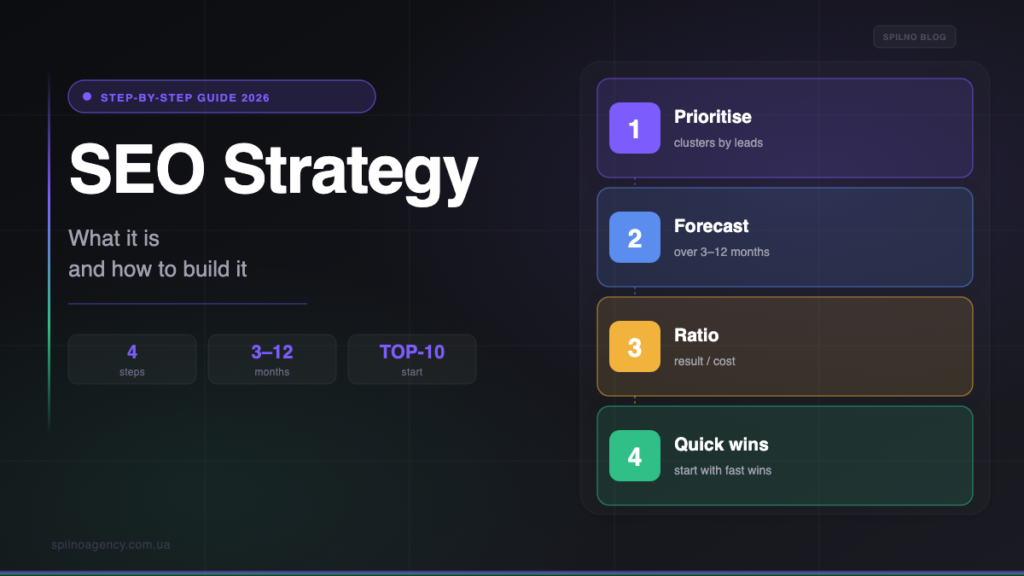
An SEO strategy is not a list of keywords — it is a plan of priorities: which query groups to promote first, what they will cost and what profit they will bring. In this guide we show how to analyse every cluster up front, score it by lead and profit potential, forecast growth over 3–12 months, derive the result-to-cost ratio — and use it to choose a strategy that starts with quick wins.
What an SEO strategy is and why you need one
Most projects begin SEO in chaos: writing copy for random queries, buying links, patching technical errors — and six months later they cannot explain what actually moved the needle or why the budget was spent that way. An SEO strategy removes that chaos. It is a document that answers three questions: what to promote, in what order, and why exactly that way.
The core idea is simple: traffic itself is not the goal. The goal is leads and profit. So the strategy is built not around “all the website’s keywords” but around query clusters sorted by revenue potential. A single cluster of 50 searches a month can earn more than another with 5,000 — if the first user is ready to buy and the second is only reading.
A good strategy delivers three things: predictability (you know what results to expect and when), budget control (you invest where the return ratio is highest) and focus (the team is not scattered across hundreds of small tasks). Below is the step-by-step method Spilno Agency uses to build strategy for European businesses.
Types of SEO strategy
“SEO strategy” is an umbrella over several approaches. In practice they are combined, but it helps to know which one is primary for your project:
- ROI-prioritised strategy — ranking clusters by the result-to-cost ratio and starting with quick wins. This is the core approach we cover in detail in this article.
- Topical authority — building a pillar page plus a cluster of supporting articles so Google sees you as an expert on the topic. Works for trust, E-E-A-T and reach.
- Competitor-gap — systematically capturing traffic: finding queries and content where competitors are strong and you are not, and closing those gaps.
- Programmatic SEO — scaling hundreds or thousands of templated pages from data (for e-commerce, aggregators, local businesses).
These strategies are not mutually exclusive. ROI prioritisation answers “what to do first”, while topical authority, competitor-gap and programmatic are ways to cover specific clusters. Below is how to build the core ROI plan step by step.
Types of search queries: how each affects leads and profit
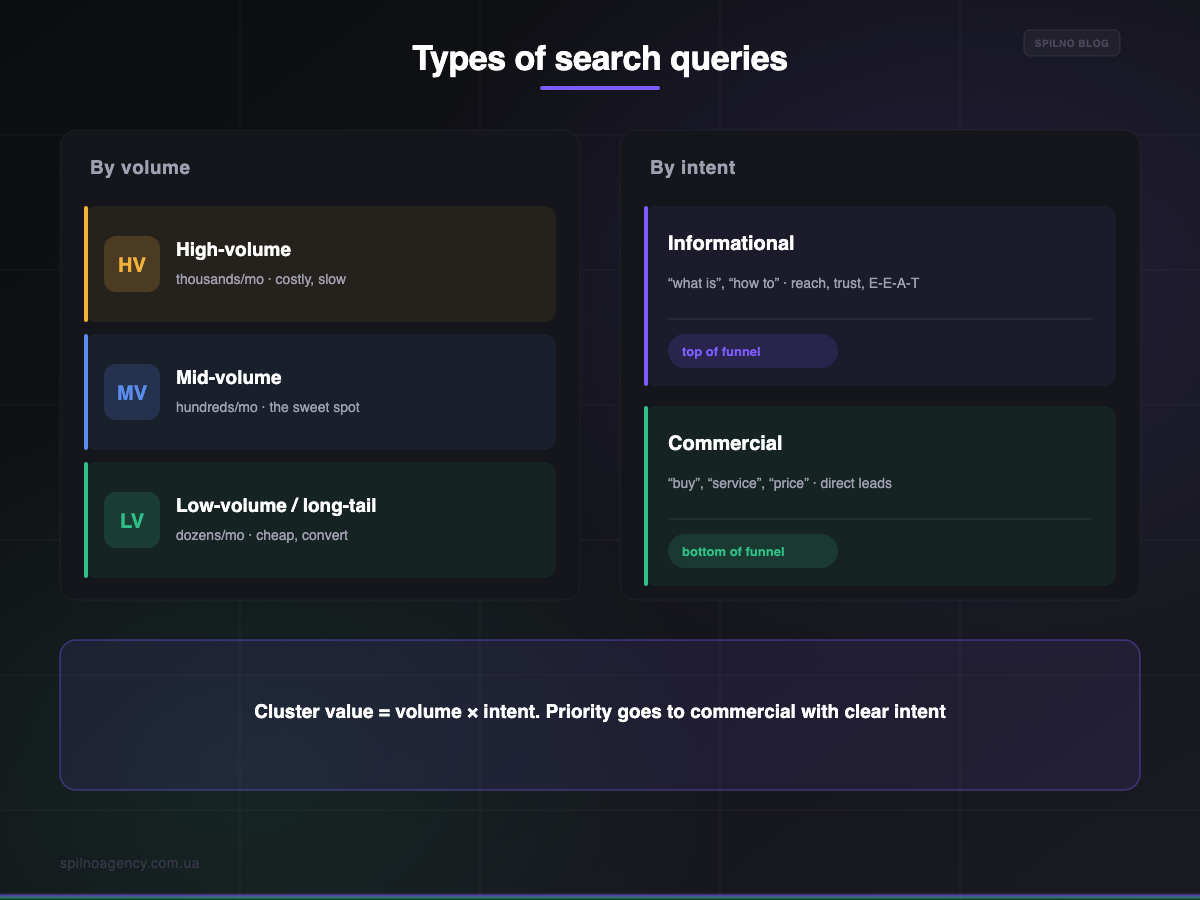
Before prioritising, you need to understand the “raw material”. Every query is classified along two axes: volume (how many people search) and intent (why they search). The intersection of these axes defines a cluster’s value to the business.
By volume: high, mid, low
- High-volume (HV) — thousands of searches a month (e.g.
seo strategy). Large volume but high competition, slow to rank and often vague intent. In a strategy this is a long-term goal, not a starting point. - Mid-volume (MV) — hundreds of searches (e.g.
how to build an seo strategy). The sweet spot: enough volume, moderate competition, clearer intent. - Low-volume and long-tail — dozens of searches or fewer (e.g.
seo strategy framework for ecommerce). Cheap, fast to rank and the most specific in intent — so they convert best.
By intent: informational and commercial
- Informational (“what is…”, “how to…”) — the user is looking for knowledge, not yet ready to buy. These build reach, trust and E-E-A-T, feed the top of the funnel and work well for GEO (visibility in AI answers).
- Commercial / transactional (“buy…”, “service…”, “pricing…”) — the user is ready to act. Lower volume but a direct link to sales. This is the bottom of the funnel and the main source of leads.
A sound strategy combines both: commercial clusters bring quick leads, informational ones build the domain authority that later lifts the commercial pages too. How these groups map onto the customer journey is covered in detail in our guide to the marketing funnel and digital-marketing tools by stage.
Step 1. Prioritise clusters by leads and profit
The first and most important part of a strategy is to analyse every query group up front rather than grabbing the first cluster you see. The algorithm:
- Collect the full semantics. Using Serpstat, Ahrefs, Google Keyword Planner and search suggestions, gather every relevant query and group them into clusters by shared intent (one page = one cluster).
- Estimate cluster volume. The combined frequency of all queries in a group is the ceiling of potential traffic.
- Define intent and proximity to money. Tag each cluster: informational / commercial, top / bottom of funnel. Commercial clusters with clear intent get higher priority.
- Forecast leads and profit. Traffic × lead conversion × average order value × margin = the cluster’s potential profit for the period. This figure — not query volume — defines value.
- Sort by priority. Build a table of all clusters and rank them by potential profit (accounting for current positions — see below).
The output of Step 1 is a ranked list of clusters, with the biggest lead and profit drivers at the top. This is the foundation: every later decision rests on this list.
Step 2. Forecast growth month by month (3 / 6 / 9 / 12) and the cost
With the cluster list ready, we build a forecast over time for each one. SEO does not deliver instantly: positions climb gradually, so the forecast spans 3, 6, 9 and 12 months (and beyond for competitive niches).
The forecast logic for a single cluster:
Forecast leads (period) =
  Cluster volume (queries/month)
  × CTR of the expected position at period end
  × session-to-lead conversion

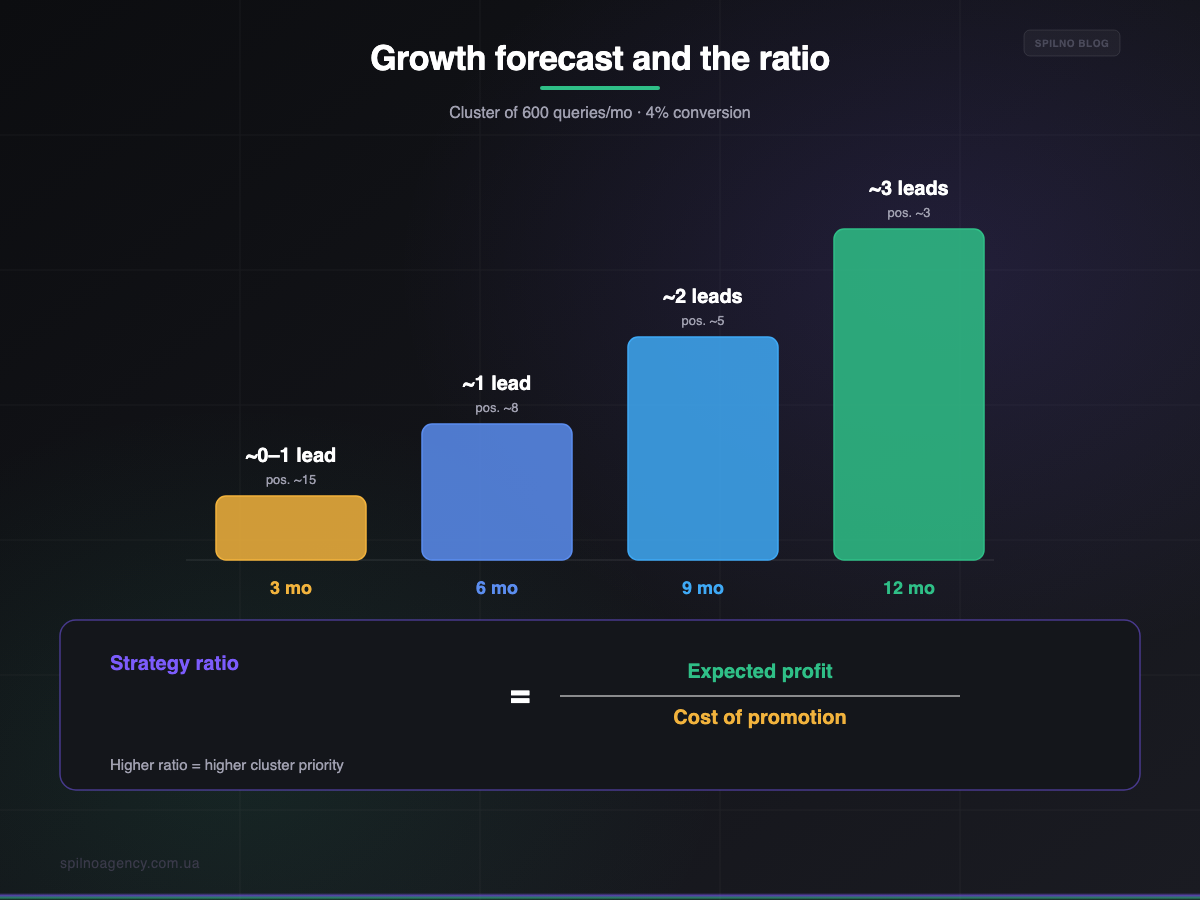
Example (commercial cluster, 600 queries/month):
   3 mo:  position ~15 → CTR 2%  → 12 visits  × 4% = ~0–1 lead
   6 mo:  position ~8  → CTR 4%  → 24 visits  × 4% ≈ 1 lead
   9 mo:  position ~5  → CTR 7%  → 42 visits  × 4% ≈ 2 leads
  12 mo:  position ~3  → CTR 12% → 72 visits  × 4% ≈ 3 leads
Alongside the result forecast we estimate the cost of promoting the cluster. It consists of content creation and optimisation, technical work, link building and team time. More expensive clusters are usually high-volume queries in competitive topics; cheaper ones are low-volume and long-tail, where quality content and minimal links are enough.
Importantly, the forecast is always a range — pessimistic, base and optimistic scenarios. A single exact number in SEO is a sign of inexperience, because results are affected by Google updates, competitor moves and seasonality.
Step 3. The result-to-cost ratio — choosing the strategy
Now every cluster has two numbers: the expected result (leads / profit for the period) and the cost of promotion. Divide one by the other and you get the strategy’s key metric:
Ratio = Expected cluster profit (per period)
        ────────────────────────────────────
        Cost of promoting the cluster (per period)
The higher the ratio, the more attractive the cluster. It is by ratio, not query volume, that the work queue is built. This saves you from the classic mistake of throwing the whole budget at a “fat” high-volume query that will not reach the top for a year and never pays off.
Based on the distribution of ratios, you choose one of the typical strategy scenarios:
- Fast-payback strategy — focus on the highest-ratio, short-horizon clusters. Right when you need leads now and the budget is limited.
- Balanced strategy — 70% of resource on high ratio + fast result, 30% on promising high-volume clusters for the long game. Optimal for most businesses.
- Reach strategy — investing in high-volume and informational clusters for market share and brand. Justified with a stable budget and a long horizon.
Step 4. Where to start — quick wins
Whichever scenario you choose, you should almost always start with quick wins. These are clusters already close to the visibility threshold: pages ranking in the top 10–20 (the second page and the bottom of the first). They need only a small push to climb to where real traffic begins.
Why this is the most profitable start:
- Minimal cost. The page is already indexed and has some authority — it needs targeted improvements, not promotion from scratch.
- The highest ratio. Moving from position 11 to 5 gives a multiple CTR uplift, whereas entering the top from position 80 takes months.
- Fast proof for trust. First leads within 1–2 months validate the strategy and justify further investment in pricier clusters.
Finding quick wins is easy: in Google Search Console or Ahrefs/Serpstat, filter for queries ranking 11–20 with meaningful impressions. That is your entry point. Only once the quick wins are captured do you move to mid-term clusters and, finally, to long-term high-volume goals.

A worked example with numbers
Imagine an online store with four clusters. After Steps 1–3, the priority table looks like this:
| Cluster | Volume/mo | Intent | Current position | Ratio | Queue |
|---|---|---|---|---|---|
| Commercial A | 600 | Purchase | 12–15 | High | 1 (quick win) |
| Commercial B | 1,200 | Purchase | 40+ | Medium | 3 |
| Informational C | 2,500 | Info | 25 | Low | 4 |
| MV service D | 300 | Service | 9–11 | Very high | 2 (quick win) |
Although cluster C has the largest volume (2,500), it goes last: informational intent, distant position, low ratio. Meanwhile the modest A and D start first — they are already near the top and the cheapest way to add leads. That is how prioritising by ratio, not volume, works.
What this approach looks like in practice — with real numbers on leads and cost per enquiry — is shown in our promotion case studies.
Example: an SEO strategy for a dental clinic
Let us apply the method to a concrete case — a private dental clinic in a mid-sized city. After collecting the semantics and clustering, the services are laid out in a table by volume, potential profit, current position and ratio (no prices shown — only relative potential):
| Cluster (service) | Volume/mo ≈ | Potential profit | Position | Ratio | Queue |
|---|---|---|---|---|---|
| Dental implants | 2,400 | Very high | 18–22 | Very high | 1 (quick win) |
| Veneers | 6,600 | High | 12–15 | High | 2 (quick win) |
| Teeth whitening | 4,400 | Medium | 9–11 | High | 3 (quick win) |
| Braces | 1,900 | High | 30+ | Medium | 4 |
| “Toothache, what to do” | 880 | Low | 25 | Low | 5 (content foundation) |
The priority logic: implants and veneers are the most expensive, high-margin services, so they sit at the top even though “whitening” has a larger search volume. The informational query “toothache, what to do” brings wide reach but almost no direct enquiries — so it is a content foundation for authority and E-E-A-T, not a starting point.
We start with quick wins: veneers (position 12–15), whitening (9–11) and implants (18–22) are already close to the top — they need targeted improvements to deliver the first leads within 1–2 months. Braces (beyond the top 30) are left for later — the most effort-heavy cluster. The resulting work queue: 1 — implants, 2 — veneers, 3 — whitening, 4 — braces, 5 — the informational foundation.
After roughly 12 months the clinic holds the top for its most profitable services (implants, veneers), while the informational cluster feeds the domain’s authority. The budget is spent by the result-to-cost ratio, not “volume for the sake of volume”.
How to build a strategy from scratch — when there is no data at all
Everything above assumes the project already has a history: positions, impressions in Google Search Console, ready quick wins. But what if the site is brand new and there is no data at all — no positions, no traffic, no GSC? The approach is the same, but the data source changes: instead of your own analytics, you temporarily use competitor and SERP data.
- Replace quick wins with “competitor gaps”. Analyse the top 10 results for your target clusters and find low-difficulty (KD) queries that competitors cover weakly or not at all. This is your entry point in place of your own positions.
- Build the forecast from a benchmark, not from positions. Use the typical ranking curve of a new domain and the actual results of competitors of similar age and Domain Rating as your reference. This gives a realistic pessimistic–base–optimistic corridor.
- Start with commercial low-volume and long-tail. Queries with minimal competition can reach the top within 2–4 months even for a young site. They bring the first leads — and, more importantly, the first data of your own.
- Build an informational foundation in parallel. A topical cluster of informational articles grows domain authority and E-E-A-T, without which commercial pages will not reach the top.
- Switch to your own data after 1–2 months. As soon as the first impressions and positions appear in GSC, return to the normal cycle: quick wins by actual positions, recalculated ratios, revised priorities.
The key idea: on a zero-data project, the goal of the first 60–90 days is not traffic but accumulating your own data. Competitor and SERP data are temporary crutches that you replace with your own analytics as soon as it appears.
Common mistakes when building a strategy
- Chasing volume, not profit. Promoting a high-volume query just because “there is a lot of traffic there” is the most expensive mistake.
- Starting with the hardest clusters. Months without results kill trust in SEO. Start with quick wins.
- No forecast and no ratio. Without numbers, a strategy becomes a wish list.
- Ignoring commercial low-volume queries. They deliver the first and cheapest leads.
- A “set and forget” strategy. Review it every quarter against actual GSC and analytics data.
Frequently asked questions (FAQ)
What types of SEO strategy are there?
Four main approaches: ROI-prioritised (by the result-to-cost ratio, starting with quick wins), topical authority (a pillar plus a cluster of articles), competitor-gap (closing competitors’ gaps) and programmatic SEO (scaling templated pages). They combine: ROI prioritisation sets the order, the others are ways to cover specific clusters.
How do you build an SEO strategy for a new site with no data?
When you have no analytics yet, competitor and SERP data temporarily replace your own. You analyse the top 10 competitors, take their low-difficulty clusters and build the forecast from a benchmark of competitors of similar age and DR. You start with commercial low-volume and long-tail queries with minimal competition — these can reach the top within 2–4 months. The goal of the first 60–90 days is not traffic but accumulating your own data, after which you switch to the normal cycle.
What is an SEO strategy in simple terms?
It is a plan that decides which query groups to promote first, how much it will cost and what result it will bring. The strategy is built around clusters sorted by lead and profit potential, and answers: what to promote, in what order, and why.
How do you start building an SEO strategy?
By collecting all the semantics and splitting it into clusters. Then estimate each cluster’s lead and profit potential and cost, derive the result-to-cost ratio and start with quick wins — pages in the top 10–20 that will bring traffic fastest.
How do high-volume queries differ from low-volume in a strategy?
High-volume brings reach but is expensive, slow and often vague in intent. Mid/low-volume is cheaper, faster and more specific, so it converts into leads better. High-volume is set as a long-term goal, while growth starts from mid/low-volume and commercial clusters.
How do you forecast results at 3–12 months?
For each cluster: query volume × CTR of the expected position at period end × lead conversion. This gives a traffic and lead forecast at 3/6/9/12 months. The forecast is always a range — pessimistic, base, optimistic.
How often should the strategy be reviewed?
Every quarter. Every three months, compare forecast against actuals from GSC and analytics, reallocate priorities and update cluster ratios for new positions and competitor moves.
Need an SEO strategy with a forecast and a payback ratio?
Spilno Agency collects the semantics, prioritises clusters by lead and profit potential, builds a 3–12 month forecast and launches promotion from quick wins — for businesses across Europe. Get in touch and we will build a strategy tailored to your niche and budget.

Read also
Google Tag Manager Workspaces: Why You Need Them and How to Use Them in 2026
A workspace in Google Tag Manager is a “draft” of a container — a place to safely edit…
How to Track Revenue, Transactions and Purchases in Google Analytics 4 from WordPress WooCommerce
Introduction WooCommerce store owners are often convinced that Google Analytics 4 already shows them revenue, transaction counts and…
How to Analyze Hourly Statistics in Google Analytics 4
Google Analytics 4 has no dedicated “hourly statistics” menu item, but you can get that exact breakdown in…