What is Advertising and Digital Advertising: Types, Channels and How to Choose in 2026

Advertising is a paid message about a product, service or brand designed to change audience behavior: capture attention, build desire, drive purchase. Today advertising splits into two large worlds — traditional (TV, radio, print, outdoor) and digital. In this guide we break down what advertising is, what types of advertising exist, how digital advertising differs, which digital advertising channels are most popular in Ukraine (Google Ads, Meta Ads, TikTok Ads, SEO), and what advertising is most effective for different types of businesses in 2026.
The article follows the Spilno Agency analysis principle: sequential numbered sections, comparative channel tables and a final conclusion with concrete steps for business.
1. What is advertising
Advertising is a paid, non-personal form of communication from an identified sponsor, distributed through media channels with the goal of informing, persuading or reminding the target audience about a product, service or brand. In simple terms: advertising is the tool that helps a business tell the right people that it exists and how it can be useful.
Advertising differs from other forms of promotion by three traits:
- Paid placement. Unlike PR or organic content, the advertiser pays for impressions, clicks, or another contact format with the audience.
- Message control. The brand decides what, to whom, when and where to say — unlike word-of-mouth or editorial coverage.
- Scalability. A single creative can reach tens of thousands of people in hours — something personal selling cannot deliver.
Over the last 20 years advertising has evolved from “buy a billboard and wait” to “launch Google Ads with $5 and see your first leads in an hour.” That shift is what gave birth to digital advertising as a separate field.
2. Types of advertising: classification
What kinds of advertising are there? The most useful classification is by placement environment. All ad types fall into three groups:
- Traditional (offline) advertising — television, radio, print, outdoor (billboards, citylights), transit ads, BTL activations.
- Digital (online) advertising — search ads in Google, social media advertising (Meta, TikTok, LinkedIn), display ads on websites, video ads on YouTube, email marketing, SEO.
- Hybrid advertising — formats that combine offline and online: digital out-of-home advertising (DOOH), QR codes on packaging, interactive shop windows, AR activations.
Another axis of classification is by campaign goal: brand (awareness), product (promotion of a specific item — i.e. product advertising), performance (sales right now), retargeting (returning users who already engaged with the brand).
3. What is digital advertising
Digital advertising is the family of ad formats placed in internet and digital channels: search engines, social networks, websites, mobile apps, email, video platforms, programmatic networks. The key difference from traditional advertising is the measurability of every audience contact.
What makes digital advertising fundamentally different:
- Precise targeting. You can show ads only to 25–34-year-olds in Kyiv interested in running who typed “marathon shoes” into Google.
- Pay for results. Classic model — CPM (per thousand impressions). Digital added CPC (per click), CPL (per lead), CPA (per action), ROAS — the business pays for getting closer to a sale.
- Full analytics. You see how many people saw the ad, clicked, bought, and how much one customer cost.
- Speed of launch and optimization. A campaign can be live in 1–2 hours, first results in a day, underperforming ads turned off the next day.
- Low entry threshold. A budget of $3/day is realistic for small business. Outdoor or TV starts at tens of thousands.
Thanks to these five properties, digital advertising has become the main customer acquisition channel for most Ukrainian companies in the last decade — from local cafes to IT exporters.
4. Digital advertising channels in Ukraine
Four channels dominate the Ukrainian market in 2026. Let’s break each down.
4.1. Google Ads (search advertising)
Search advertising in Google Ads is the most direct way to reach a person who is looking for your service or product right now. The user types “buy bicycle Kyiv” and sees your ad in the top spot. You only pay when they click through to the site.
What’s inside Google Ads:
- Search — text ads in search results, the core performance tool.
- Display — banner ads on Google partner sites (over 2 million placements).
- YouTube Ads — video ads before, during, or instead of YouTube videos.
- Performance Max — automated campaign where Google distributes budget across all formats to hit the goal.
- Shopping — product ads with photo, price, and shop name for e-commerce.
Best for: any business with formed demand — from dentistry to B2B services. Especially effective for high-margin services with a short decision cycle.
4.2. Meta Ads (Facebook and Instagram)
Meta Ads is advertising on Facebook, Instagram and Messenger through the unified Meta Ads Manager. Unlike Google search, where you catch existing demand, on Meta you create demand: showing ads to people who weren’t thinking about your product yet but are likely to be interested.
Strengths of Meta Ads:
- Best lookalike audience algorithm in the world — finds people similar to your customers.
- Deep behavioral and interest targeting.
- Strong visual formats: Stories, Reels, Carousel — ideal for brand and product advertising.
- Ready e-commerce infrastructure: catalogs, Instagram shops, dynamic retargeting.
Best for: B2C brands, e-commerce, local services, infobusiness. Less effective for narrow B2B niches.
4.3. TikTok Ads
TikTok Ads is the youngest of the four channels and the fastest-growing in Ukraine. If in 2022 it was a teen platform, by 2026, 60% of TikTok’s Ukraine audience are 25–44-year-olds with active purchasing power.
TikTok Ads features:
- Content nativity — ads that look like organic videos (UGC style) deliver 3–5× the CTR of classic ad videos.
- Formats: In-Feed Ads, Spark Ads, TopView, Branded Hashtag Challenge.
- Cheap reach CPM — on average 1.5–2× lower than Meta at comparable scale.
- High engagement — average watch time per video is higher than Instagram Reels.
Best for: brands with a younger audience, FMCG, fashion, beauty, e-commerce, edtech. Weak for expensive B2B services.
4.4. SEO (organic search)
SEO is technically not advertising — you don’t pay Google for impressions. But SEO sits alongside Google Ads, Meta and TikTok as a core acquisition channel. Instead of paying per click, you invest in content and technical optimization so the site reaches the top of organic results.
Why SEO matters for business:
- Cheapest traffic in the long run. An article that hits Google’s top brings traffic for years — without per-click costs.
- Audience trust. 70% of users click organic results, ignoring the ad block on top.
- Reinforces other channels. A strong site with quality content converts paid traffic better.
- GEO-ready (Generative Engine Optimization). Content optimized for SEO becomes a citation source in ChatGPT, Perplexity and Google AI Overviews.
The downside of SEO is slowness: first results in 3–6 months, meaningful traffic in 9–12. Read more in our guide “What is a Blog and Why Does Your Business Need One”.
5. Digital advertising channels compared
To pick the right channel, look at four parameters: speed of result, starter budget, primary content type and which funnel stage the channel is strongest at.
| Channel | Speed | Budget/mo | Content | Funnel |
|---|---|---|---|---|
| Google Ads | 1–3 days | from $130 | Text, product feed | Bottom (formed demand) |
| Meta Ads | 5–14 days | from $200 | Photo, video, Reels | Middle + Bottom |
| TikTok Ads | 7–21 days | from $260 | Vertical video | Top + Middle |
| SEO | 3–6 months | from $400 | Articles, guides, media | All stages |
6. Digital out-of-home advertising (DOOH)
Digital out-of-home advertising (DOOH) is a hybrid format that combines billboard reach with the flexibility of digital. These are electronic screens in malls, on streets, in transit, and at gas stations playing ads by schedule or in real time.
How DOOH differs from classic outdoor advertising:
- Dynamic content. The same screen shows coffee in the morning, pizza in the evening, a concert on weekends.
- Programmatic buying. You can buy impressions through an RTB exchange — for two hours, not two weeks.
- Trigger scenarios. Umbrella ads turn on when it rains; cold drinks when temperature exceeds 25°C.
- Cross-channel measurability. You can measure how many people opened the website on mobile after seeing a DOOH ad.
In Ukraine, DOOH is available in Kyiv, Lviv, Odesa, Dnipro. Budget — from $800 for a one-week campaign. Best for image campaigns of large brands and product launches with a local angle.
7. What advertising is most effective
The question “what advertising is most effective” is poorly framed. The right question is “what advertising is most effective for my business model and funnel stage.” Effective advertising is what brings you customers at an acceptable cost, not what has the highest CTR.
Three typical channel stacks for different business types:
- E-commerce (clothing, beauty, electronics): Google Shopping (40%) + Meta dynamic retargeting (35%) + TikTok Ads (15%) + SEO for category pages (10%). The channels reinforce each other.
- Local services (dentistry, auto repair): Google Ads Search (60%) + Local SEO (30%) + Meta Ads on local audiences (10%). Google dominates because people search “dentist Kyiv Podil.”
- B2B services (agencies, SaaS, consulting): SEO + content marketing (50%) + LinkedIn Ads (25%) + Google Ads Search (25%). B2B has a long decision cycle, so the foundation is expert content.
What makes advertising effective regardless of channel: clear target audience, relevant offer, high-converting landing page, and analytics tuned for optimization. Without these four, even the best channel will not deliver ROI.
8. How to pick an ad channel for your business: 5 steps
The framework we use at Spilno Agency to recommend a channel:
- Define the goal. What’s more important now — fast sales (performance) or brand awareness? This halves the channel list.
- Describe the audience. Who is your customer by age, geo, income, behavior? An 18–24 TikTok audience ≠ a 35–55 Facebook audience ≠ a B2B LinkedIn audience.
- Assess demand. Do people google your product? If yes — Google Ads + SEO are mandatory. If not (new product, innovation) — focus on Meta and TikTok to create demand.
- Allocate test budget. Pick 2–3 channels for the first test in a 60/30/10 ratio. Don’t spread $130 across 5 channels.
- Measure and re-optimize. After 4 weeks calculate CAC and ROAS per channel. Scale the best, kill the worst.
9. FAQ
What is advertising in simple words?
Advertising is a paid message about a product or service that a business shows to a target audience to attract customers and increase sales.
How is digital advertising better than traditional?
Digital advertising offers precise targeting, pay-for-result models, full analytics and a low entry threshold — from $3/day. Traditional advertising works on mass reach without clear ROI measurability.
How much does Google advertising cost in Ukraine in 2026?
It depends on the niche. Benchmarks: local services from $130/mo, e-commerce from $400/mo, competitive B2B from $800/mo. Average Search Ads CPC is 6–25 UAH depending on industry.
What is digital out-of-home advertising?
Digital out-of-home advertising (DOOH) is electronic screens on streets, in malls and in transit that play dynamic ad videos, combining billboard reach with programmatic flexibility.
Which channel should I start with at $260?
For most businesses — Google Ads Search with tight geo targeting. It delivers the fastest results on existing demand. Add Meta Ads in 1–2 months to scale.
10. Conclusion
Advertising in 2026 is digital first. Four channels — Google Ads, Meta Ads, TikTok Ads and SEO — cover 90% of a Ukrainian business’s customer acquisition needs. Digital out-of-home and traditional offline formats remain a tool for image campaigns of large brands.
If you’re just starting — pick one channel for your funnel, set a 4-week test budget, measure CAC and ROAS, and only then scale. Don’t try to launch “all channels at once” — that’s the shortest path to burning the budget without results.
At Spilno Agency we build advertising strategies for Ukrainian and international brands — from the first test launch to scaling across dozens of countries. Contact us to discuss a strategy for your business.

Read also
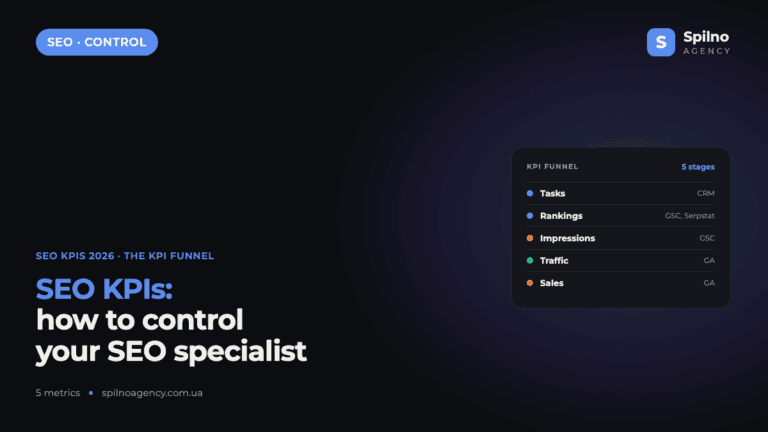
How to Control an SEO Specialist: The 5-Stage SEO KPI Funnel
SEO KPIs form a chain of five metrics that show, step by step, whether your SEO is actually…
Best CMS for an Online Store: Cloud vs Self-Hosted Platforms in 2026
Compare Shopify, WooCommerce, PrestaShop, OpenCart and Magento for your online store. Pros, cons, and a step-by-step CMS selection…
LinkedIn Ads Library: How to Find Your Competitors’ LinkedIn Ads (2026 Guide)
How to use the LinkedIn Ads Library to see any competitor's sponsored content for free — step by…