What is Contextual Advertising: Types, Costs, How It Works — 2026 Guide

Contextual advertising is paid ads in search engines, on websites, and in apps that are shown to a user based on their query, interests, or online behavior. In this guide, we’ll cover how contextual advertising works in 2026, its different types, its cost in Ukraine, what services are included in contextual advertising for businesses, and how to choose an agency without overpaying.
The article is structured according to the Spilno Agency analysis principle: sequential numbered sections, comparative tables of channels by funnel stages (impression → click → conversion), and a final conclusion with concrete steps for your company.
1. What is Contextual Advertising in Simple Terms
In simple terms, contextual advertising means ads that Google shows a person in response to their own search query. You pay not for placement or impressions but for visits to your website: the budget is only spent when someone clicks.
Here is what it looks like in practice: someone types “air conditioner repair Warsaw” into Google — and above the regular results they see several listings marked “Ad”. These companies didn’t wait months for their site to climb the organic rankings: they set up an ad account, and Google started showing their offer the same day. The customer is as “hot” as it gets — they are looking for the service right now.
Why it matters for your business: contextual advertising is the fastest way to test demand and get your first leads online. If your website is ready to take orders, the first inquiries usually arrive within the first week after launch.
Contextual advertising is an online advertising format where ads are selected based on the “context”: what the user has recently searched for on Google, what they are interested in, or the websites they are browsing. In other words, contextual online advertising shows a product or service precisely when a person has shown interest in it.
A classic example: a user enters “buy Nike sneakers Kyiv” into Google — and sees several ads marked “Ad” above the organic search results. This is contextual website advertising — the ad is shown in the context of a commercial query.
Unlike random banner ads, context works on the principle of “the right message — to the right person — at the right time”. Therefore, contextual advertising for businesses remains the fastest way to get online sales in 2026.
2. How Contextual Advertising Works — The Auction Mechanic
Every time someone enters a query, Google runs a split-second auction between advertisers: whose ads to show and in what order. The key point: the winner is not the one who bids the highest price per click. Google also scores quality — how well the ad and the page it leads to match what the user is looking for.
For a business owner this is the crucial detail: a carefully configured campaign with a clear ad and a convenient landing page costs less than a competitor’s account that is simply “flooded with money”. The same lead can cost €5 or €20 — the difference lies in the quality of the setup, not the size of the budget.
Every ad impression is a mini-auction that Google conducts in milliseconds. The winner is not the one who pays more, but the one with the higher Ad Rank = bid × Quality Score × device and query context.
What this means for business: contextual advertising for a company with a relevant landing page, a clear ad, and set up analytics can cost 3–5 times less than the same advertising with a typical “created an account and launched” approach.
3. Types of Contextual Advertising in 2026
Contextual advertising is not limited to search. Today, there are 5 main formats, each covering a different stage of the funnel.
Advertising on Facebook and Instagram is a different story. There, people are not searching for anything: they scroll the feed, and ads find them based on interests and behavior. Formally this is a different type of advertising — targeted. In practice the two channels often work in tandem: contextual advertising captures those already searching for your product, while social media reminds everyone else about you.
Separate from these are Meta Ads (Facebook and Instagram) — these are not contextual but targeted ads based on interests and behavior, yet they are often combined with contextual advertising into a single performance strategy.
4. Contextual Advertising vs. SEO vs. SMM — Channel Comparison
Where should the first advertising budget go — contextual advertising, SEO, or social media? There is no universal answer: it depends on how quickly you need leads and whether you are ready to invest long-term. The table below compares the three channels on practical questions: when the first customers arrive, how much it costs to enter, and what happens if you pause the channel.
This is a key table for understanding where to invest your budget. Using the Spilno Agency methodology, we compare channels not just by “expensive/cheap,” but by funnel stages and speed of results.
| Parameter | Contextual Advertising | SEO | SMM (Meta Ads) |
|---|---|---|---|
| First Leads | 1–7 days | 3–6 months | 3–14 days |
| Demand Type | Hot (already searching) | Hot + Warm | Cold (creating demand) |
| Cost Per Lead (CPL) | Medium | Lowest in the long run | Medium–High |
| What happens if turned off | Leads drop the next day | Traffic holds for 6–12 months | Leads drop in 1–3 days |
| Funnel Stage | Purchase / Lead | All stages | Awareness / Interest |
| Starting Budget/Month | from 12,000 ₴ | from 18,000 ₴ | from 10,000 ₴ |
Conclusion from the table: contextual advertising is the fastest channel for scaling sales, but not self-sufficient. In 2026, the formula “context + SEO” works: context brings leads today, SEO reduces CPL tomorrow.
5. How Much Does Contextual Advertising Cost in Ukraine in 2026
The budget for context consists of two parts: advertising budget (which goes to Google) and contextual advertising services (the work of an agency or freelancer). Approximate benchmarks for CPC and CPL by niche:
| Niche | CPC (UAH) | CPL (UAH) | Website Conversion Rate | Starting Budget |
|---|---|---|---|---|
| E-commerce (clothing, electronics) | 3–8 | 80–250 | 1.5–3 % | 25,000 ₴ |
| Services (lawyers, medicine) | 10–35 | 200–700 | 3–6 % | 15,000 ₴ |
| B2B / SaaS | 25–80 | 600–2,500 | 2–4 % | 30,000 ₴ |
| Real Estate, New Developments | 12–40 | 400–1,800 | 2–5 % | 40,000 ₴ |
| Local Services (car service, repair) | 5–18 | 100–400 | 4–8 % | 12,000 ₴ |
Agency fees: in Ukraine, a fixed fee for managing contextual advertising in 2026 ranges from 8,000 ₴/month per account or 10–15% of the advertising budget (for budgets of 50,000 ₴+). Some agencies work on a pay-for-performance model — payment only for achieving KPIs.
The data above are real ranges from our clients in 2026. You can see specific examples in the Spilno Agency case studies.
6. Contextual Advertising Services — What an Agency’s Work Includes
Contextual advertising services are not just about “setting up campaigns in Google Ads.” Quality management consists of 6 blocks of work.
- Audit and Strategy. Analysis of the niche, competitors, seasonality, and current performance metrics. Development of a media plan with forecasts for CPC, CTR, and number of leads.
- Analytics Setup. Google Analytics 4, Google Tag Manager, conversion tracking (leads, calls, purchases), importing offline conversions from CRM. Without analytics, contextual advertising is a lottery.
- Campaign Creation. Account structure, keyword research, ad copywriting (at least 3 variations per group), creatives for display/video, feeds for Shopping/PMax, bid settings.
- Management and Optimization. Daily monitoring, negative keywords, A/B testing, bid adjustments, budget reallocation between campaigns. Industry standard is optimization 2–3 times a week.
- Landing Page Work. If the landing page is poor, there will be no conversion regardless of cost. The agency provides recommendations or conducts landing page A/B tests.
- Reporting and Communication. Weekly or monthly reports with actual vs. planned performance, conclusions, and action plan for the next period.
💡 Tip: If an agency’s proposal doesn’t include items 2 (analytics) and 5 (landing page) — it’s a red flag. Contextual advertising without analytics doesn’t work, and without a good landing page, it just wastes budget.
7. Top 7 Business Mistakes in Contextual Advertising
Over 5+ years of managing contextual advertising for businesses in various niches, we’ve seen the same pitfalls. Here’s a list to watch out for:
- Launching without conversion tracking. You don’t know which campaigns are generating leads and which are wasting budget. Google AI doesn’t know either — and doesn’t optimize the campaign.
- Broad Match without control. Broad match + automated strategies = your ads showing for queries like “free,” “essay,” “job vacancy.” Budget melts away in days.
- One landing page for all campaigns. A user searches for “red Nike Air Max size 42” and lands on the store’s homepage — conversion drops 3–5 times.
- Ignoring negative keywords. The negative keyword list needs weekly updates for the first 2 months, then monthly. Otherwise, website contextual advertising pays for irrelevant traffic.
- Relying solely on PMax. Performance Max is a powerful tool, but without manual search campaigns for branded and category queries, it “eats up” branded traffic at an inflated CPC.
- Lack of remarketing. 95–98% of visitors don’t buy on their first visit. Without remarketing, you pay Google for each new contact — instead of targeting those already familiar with the brand.
- Changing strategy weekly. Google’s algorithms take 2–3 weeks to learn. If you change bids, budgets, and structure weekly, the campaign won’t achieve a stable CPL.
8. How to Choose a Contextual Advertising Agency — Checklist
Company contextual advertising is a long-term collaboration. Here are 8 questions to ask an agency before signing a contract:
- Show me case studies in my or a related niche with real CPL and ROAS figures, not just screenshots of “traffic increased.”
- Who specifically will manage my account and what is their Google Ads certification?
- How do you set up conversion tracking — via GTM, directly in the code, via CRM integration?
- What KPIs do you fix in the contract: CPL, ROAS, CPA, number of leads?
- Who owns the advertising account — me or you? (The correct answer is the client).
- How often do you optimize campaigns — daily, 2–3 times a week, weekly?
- How much does it cost to transfer my account to another agency / for self-management?
- What does a monthly report look like — can I see an example?
If the agency answers 3+ questions vaguely or evasively — it’s a reason to look further. A qualified Google Ads specialist will have clear answers to all 8 questions.
9. Frequently Asked Questions About Contextual Advertising (FAQ)
Is contextual advertising Google Ads?
Google Ads is the most popular contextual advertising platform, but not the only one. Contextual advertising also includes Bing Ads (Microsoft Advertising). In 2026, 95+% of the Ukrainian context market is Google Ads.
How long does it take for contextual advertising to become profitable?
First leads appear within 1–7 days after launch. Achieving a stable cost per lead takes 3–6 weeks (algorithm learning period). Profitability depends on margin: for e-commerce with a 30% markup, it’s usually 1–3 months; for services with a high average check, it’s 1–2 weeks.
What is the minimum budget for contextual advertising?
The minimum sensible budget is 10,000–12,000 ₴/month advertising budget for local businesses and 25,000 ₴/month for e-commerce. With less, Google’s algorithms don’t get enough data for optimization, and the campaign gets stuck in “learning” mode.
How does contextual advertising differ from targeted advertising?
Contextual advertising is shown to people who are actively searching for your product (hot demand). Targeted advertising (Meta Ads, TikTok Ads) is shown to people who fit your customer profile based on interests, age, behavior (creating demand). Context is better for quick sales, targeting is for reaching new audiences.
Can I manage contextual advertising myself?
Yes, you can. Google Ads has a user-friendly interface and free certification. Self-management makes sense for very small budgets (up to 10,000 ₴/month) or for an experienced marketer. For all other cases, an agency will save more than it costs — by optimizing auctions and campaign structures.
What is Quality Score and why is it important?
Quality Score is a Google rating from 1 to 10 that indicates how relevant your ad is to the search query. A high QS (8–10) reduces CPC by 2–3 times and improves your position in the auction. It depends on three factors: expected CTR, ad relevance, and landing page quality.
Is contextual advertising forever, or can it be turned off after SEO?
The ideal model is to partially replace context with SEO once organic traffic stabilizes (12–18 months). However, it’s not advisable to turn off context completely: it covers branded queries (competitor protection) and new commercial queries that SEO hasn’t yet ranked for. In 2026, a typical budget allocation for a mature business is: 40% context / 40% SEO / 20% SMM.
How does contextual advertising online differ from offline advertising?
Contextual advertising online is shown only to people who are already searching for a specific product or service — unlike TV, outdoor, or print ads, which reach everyone regardless of interest. This makes ad spend more efficient: you pay to reach someone already in the process of searching for a solution, not for exposure to a random audience.
Conclusion: When and How to Launch Contextual Advertising
The Situation. Contextual advertising in 2026 is not just “one of the channels” but a sales infrastructure for any business with an online presence. Its rapid launch time (1 week) and predictable results (1–3 months to profitability) make it indispensable for starting and scaling.
What Businesses Should Do.
- If you don’t have context — start with a Search campaign for 2–3 hottest queries (budget 10–15 thousand ₴ for a 30-day test).
- If context is already running but “not profitable” — order an independent account audit (usually free from reputable agencies).
- Do not launch context without setting up conversions in GA4 — analytics first, then money.
- Do not choose an agency based solely on price — the difference between “8,000 ₴/month management” and “20,000 ₴/month management” pays for itself 3–5 times over due to lower CPL.
Need an audit or contextual advertising launch?
Spilno Agency is an ROI-driven team. We’ll calculate a media plan and show you the real cost of leads in your niche.
Request a Consultation

Read also
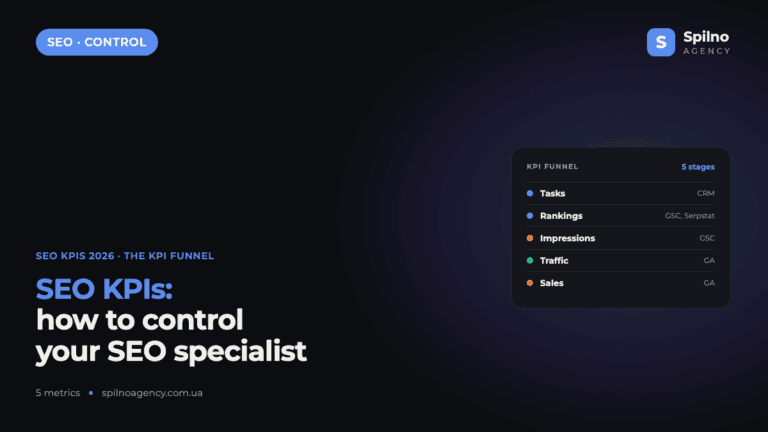
How to Control an SEO Specialist: The 5-Stage SEO KPI Funnel
SEO KPIs form a chain of five metrics that show, step by step, whether your SEO is actually…
Best CMS for an Online Store: Cloud vs Self-Hosted Platforms in 2026
Compare Shopify, WooCommerce, PrestaShop, OpenCart and Magento for your online store. Pros, cons, and a step-by-step CMS selection…
LinkedIn Ads Library: How to Find Your Competitors’ LinkedIn Ads (2026 Guide)
How to use the LinkedIn Ads Library to see any competitor's sponsored content for free — step by…