Car Service and Auto Repair Shop Advertising in Google Ads and Meta Ads

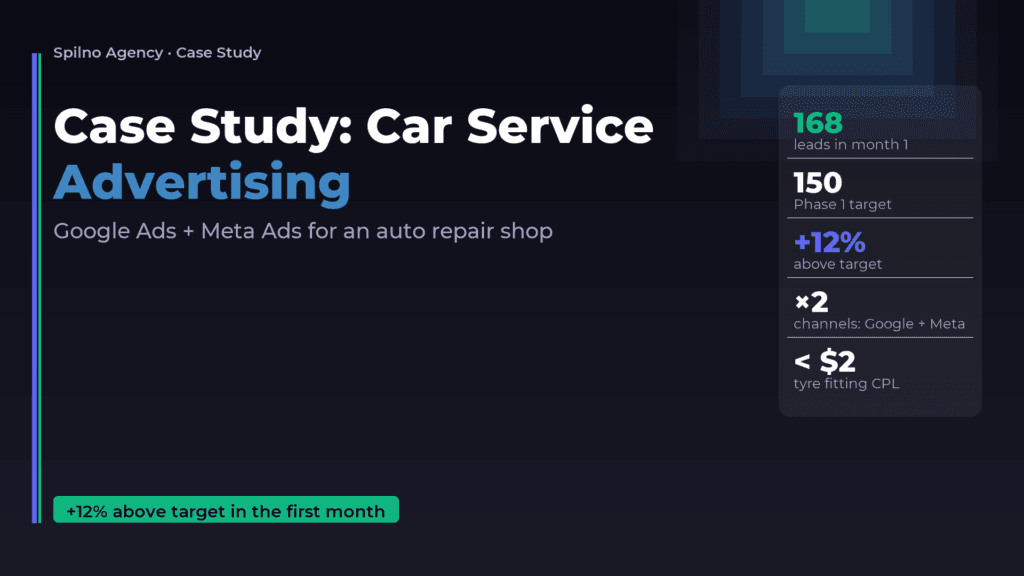
An auto repair shop at the junction of three small towns approached Spilno Agency with a critical issue: the previous agency had been generating calls from the wrong regions, and the goal of 250 leads per month remained out of reach. In the first month of work we exceeded Phase 1 by 12% — 168 leads instead of 150. A case study on auto repair shop advertising with Google Ads and Meta Ads.
About the Client
The client is a full-service car repair shop and MOT station (STO), located at the junction of three small towns in Ukraine. The business covers a broad range of services:
- General car servicing and repair (engine, suspension, brakes, oil service).
- Tyre fitting and seasonal tyre storage.
- Tyre sales and automotive accessories.
- Bodywork and paint repair.
Being at the crossroads of three populated areas is a competitive advantage — the potential audience is significantly wider than for a typical single-city garage. But it also created targeting challenges: the previous agency couldn’t configure the right geographic settings, and a large portion of the budget was wasted on calls from people too far away to be real customers.
The Challenge: Off-Target Calls and Inefficient Campaigns
Before we started, the client already had experience working with a marketing agency. Our audit revealed the following problems:
- Calls from wrong regions. Google Ads geo-targeting was set to “People interested in this location” instead of “People in this location” — showing ads to users who might just be browsing, not nearby.
- No analytics. Leads were not being tracked in Google Analytics 4, making it impossible to determine which campaigns were driving real customers.
- Campaigns running on autopilot. Some campaigns had been spending budget for months without generating any conversions — nobody had turned off the underperforming ones.
- Meta Ads not launched. The second most effective channel for local businesses wasn’t being used at all.
After the initial meeting, a clear goal was set: 250 leads per month. A lead is defined as a unique call + callback request + website form submission. Tyre fitting enquiries were tracked separately (CPL under $2 — too low-value to mix with strategic KPIs).
Phase 1 target: reach 150 leads in the first month of work.
Strategy: 6 Steps to Results
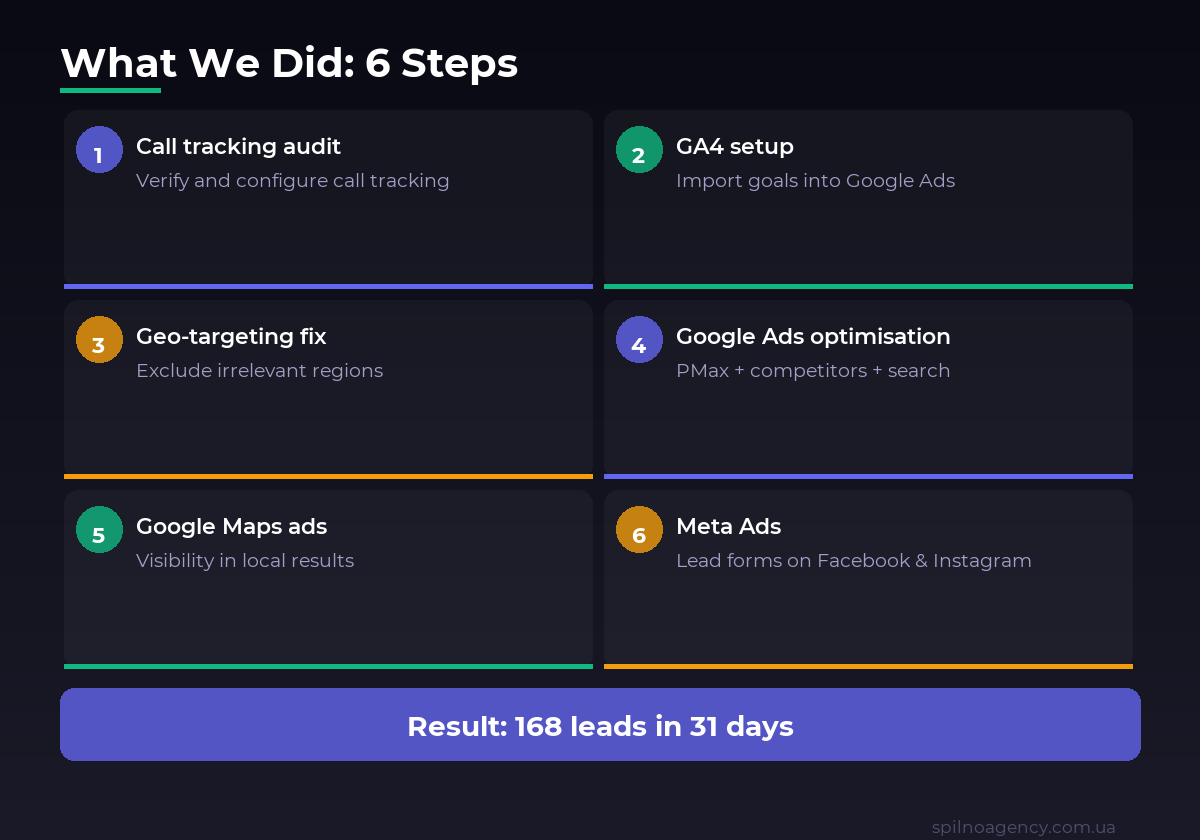
1. Dedicated Project Team
A dedicated Spilno Agency team was assigned to the project:
- Project Manager — coordination, weekly reports, bi-monthly client calls.
- Internet Marketer — managing Google Ads and Meta Ads accounts, ongoing optimisation.
- Team Leader — strategy oversight, quality control on key decisions.
2. Call Tracking Audit and GA4 Setup
The first step was building a solid analytics foundation. Without accurate data, any optimisation is guesswork. We:
- Audited the call tracking service and fixed attribution errors.
- Set up form tracking and callback event tracking in Google Analytics 4.
- Imported conversion goals into Google Ads to enable smart bidding on real leads.
- Created remarketing audiences in GA4 for Meta Ads retargeting.
3. Geo-Targeting Fix
This was the most critical fix. We reconfigured geo-targeting across all Google Ads campaigns:
- Switched from “People interested in this location” to “People in this location” across all campaigns.
- Defined a precise radius covering all three target towns based on realistic drive time.
- Excluded specific locations that had been generating off-target calls.
4. Google Ads Campaign Optimisation
Following the account audit, we carried out a full campaign restructure:
- Paused or rebuilt underperforming campaigns that were spending budget without conversions.
- Reallocated budget towards the highest-performing service categories (repair and servicing).
- Launched Performance Max — covering Google Search, Display, YouTube, and Maps simultaneously.
- Launched competitor campaigns — capturing intent from users searching for specific local garages.
- Rewrote ad copy with a focus on location, guarantee, and turnaround time.
5. Google Maps and Local Reach
Performance Max combined with an optimised Google Business Profile delivered a strong boost in local search results. Google Maps campaigns became one of the best-converting lead sources — users searching for “car service near me” have strong purchase intent and convert at higher rates than generic search traffic.
6. Meta Ads Launch
In parallel with Google Ads optimisation, we launched Facebook and Instagram advertising:
- Meta lead forms — a frictionless way to capture enquiries without requiring a website visit.
- Targeting car owners within a defined radius of the workshop.
- Retargeting website visitors who hadn’t submitted an enquiry.
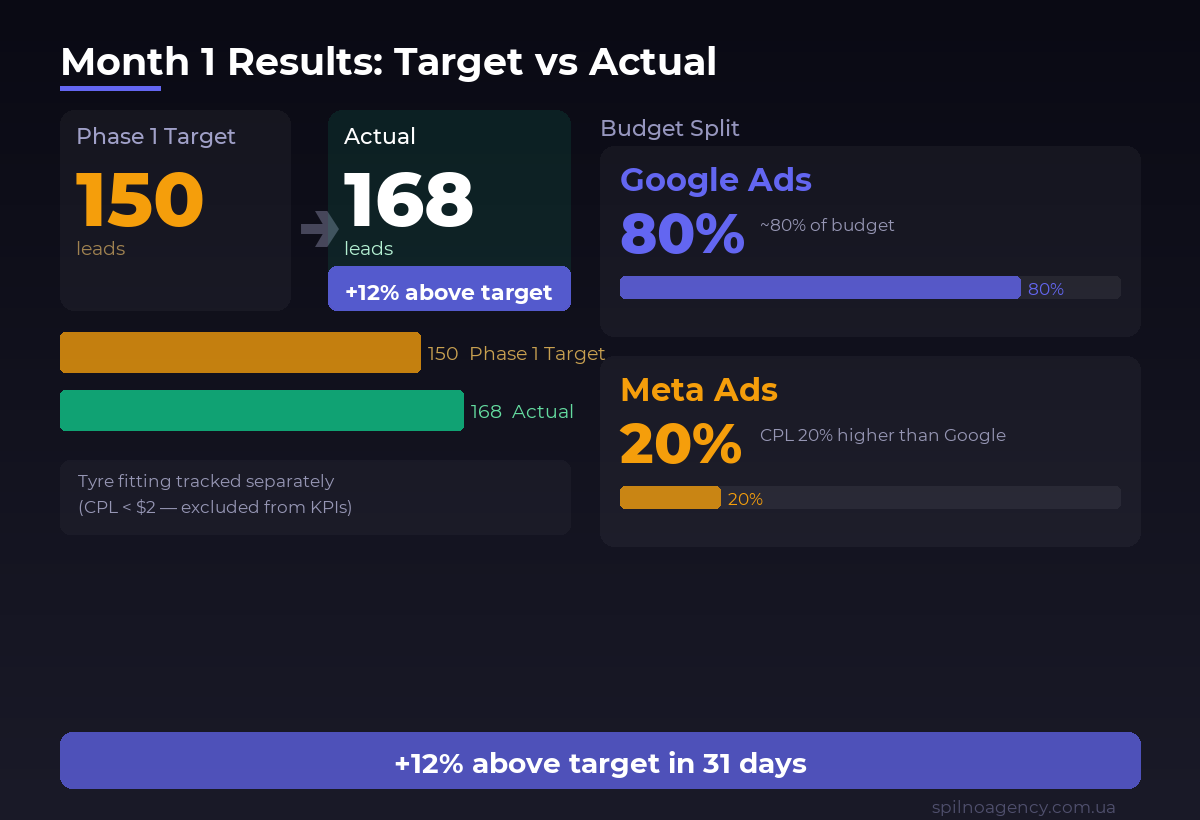
Meta Ads delivered results, but CPL came in 20% higher than Google Ads. As a result, budget allocation is approximately: ~80% Google Ads, ~20% Meta Ads.
Results: Phase 1 Exceeded
After 31 days of work, the results were:
| Metric | Phase 1 Target | Actual | Performance |
|---|---|---|---|
| Leads (calls + forms) | 150 | 168 | +12% above target |
| Primary channel | Google Ads | Google Ads | ~80% of budget |
| Supporting channel | Meta Ads | Meta Ads | ~20% of budget |
| Meta vs Google CPL | — | +20% in Meta | Budget shifted to Google |
| Tyre fitting leads | Tracked separately | Tracked separately (CPL < $2) | Excluded from KPIs |
What Worked Best
- Competitor campaigns. Searches for specific local garages represent hot intent — people already planning to book a repair. Our ads captured a share of that traffic.
- Performance Max + Google Maps. Local search results are the highest-converting traffic source for an auto repair shop. PMax provided coverage across search, Maps, and YouTube simultaneously.
- Correct geo-targeting. After fixing the settings, off-target calls from distant regions disappeared — every penny of budget reached genuine potential customers.
- Analytics as the foundation. Without properly configured GA4 and call tracking, we wouldn’t have known which campaigns were actually converting. Data-driven optimisation enabled consistent improvements.
Next Steps: Phase 2 — Target 250 Leads
After successfully completing Phase 1 (150 → 168 leads), the growth roadmap includes:
- Google Ads scaling — increasing budget on the best-performing campaigns and testing new ad groups targeting seasonal demand.
- Meta Ads expansion — A/B testing creatives, broadening audiences by car brand and seasonal needs (tyre change season, pre-winter service).
- SEO — organic traffic from local search queries to reduce dependence on paid channels.
- Google Business Profile — deeper optimisation: photos, review management, regular posts, Q&A.
Conclusion
Auto repair shop marketing with Google Ads and Meta Ads is more than just “launching campaigns”. It requires correct geo-targeting, analytics that genuinely captures every lead, and continuous data-driven optimisation. In the first month of work, Spilno Agency helped this car service exceed their Phase 1 target by 12% — 168 leads against a plan of 150.
If you need effective advertising for your car service or auto repair shop — contact us. We’ll carry out a free audit and propose a strategy tailored to your business.
Frequently Asked Questions
How to advertise a car service or auto repair shop on Google Ads?
To run effective Google Ads for an auto repair shop: set up call tracking and GA4 to measure calls and form submissions, launch search campaigns targeting ‘car repair + city’ queries, add Performance Max for Google Maps and YouTube reach, run competitor campaigns, and set geo-targeting to your city radius only. Add negative keywords (DIY, videos, free) to cut irrelevant traffic.
Which is better for a car service — Google Ads or Meta Ads?
Google Ads works better for hot demand — customers already searching for repairs. Meta Ads (Facebook and Instagram) is more effective for retargeting and reaching car owners by interest-based targeting. In our case study, Meta Ads CPL was 20% higher than Google, so the majority of budget (~80%) stayed in Google Ads while Meta (~20%) served as a retargeting channel.
How many leads can an auto repair shop generate from paid ads in the first month?
In our case study — 168 leads in the first month against a target of 150. A lead is defined as a unique call + callback request + form submission. Tyre fitting enquiries were tracked separately (CPL under $2) and excluded from the main KPIs. Actual results depend on city, budget, and niche competition.
How to fix the problem of calls from irrelevant regions?
This is a common issue for local auto repair shops. The fix: set geo-targeting in Google Ads to “People in this location” (not “People interested in this location”), define a precise radius around your workshop covering all target towns, and exclude locations that generate off-target calls. In Meta Ads, restrict the audience to your service area radius.
How to track the effectiveness of advertising for an auto repair shop?
Set up Google Analytics 4 to track form submissions, import goals into Google Ads. Connect call tracking (e.g. Ringostat, CallRail) to attribute calls to their traffic source. For Meta Ads, install Meta Pixel with Lead events. Important: track tyre fitting leads separately — their value is much lower than repair leads, and mixing them distorts your CPL figures.

Read also
How Claude Helps Spilno Agency: Google Merchant Coverage in Google Ads
An online store lists 1,375 products in Google Merchant — but how many of them are actually running…
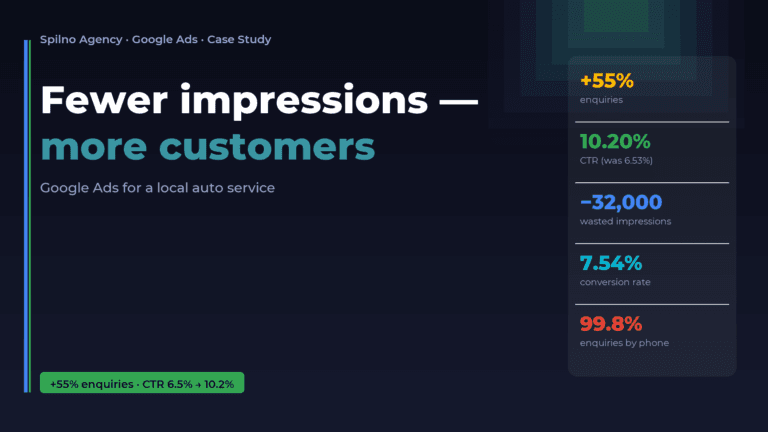
Google Ads for a Local Auto Service: Fewer Impressions, More Customers (Case Study)
A local auto service was spending its ad budget on tens of thousands of cheap impressions that barely…
Google Merchant API Changes: Migrate or Request an Extension by August 18, 2026
On August 18, 2026 Google sunsets the Content API for Shopping — migrate to the Merchant API or…