Promoting a Translation Agency via Google Ads: From 0 to 94 Leads

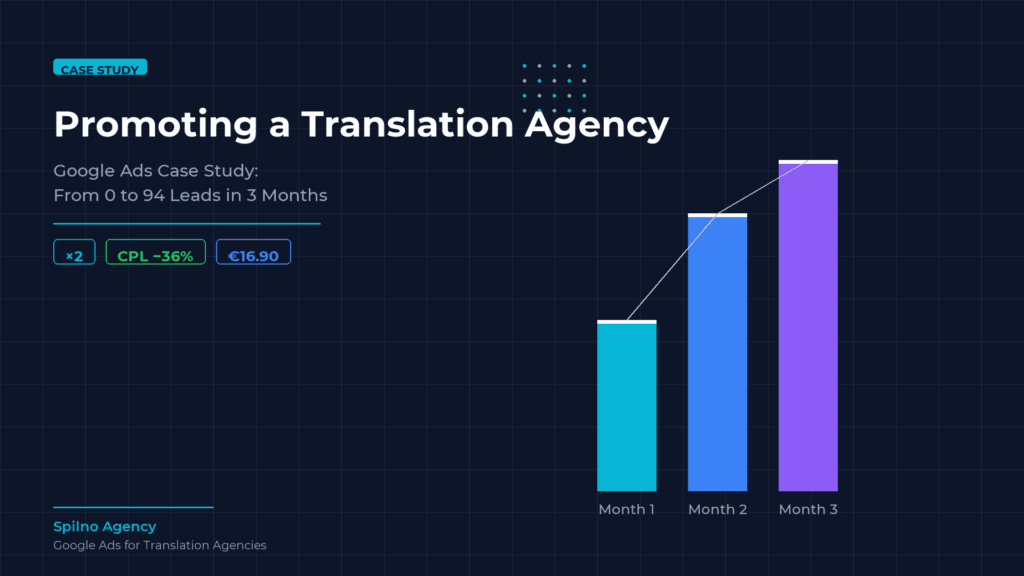
This case study is prepared by the digital marketing agency Spilno.
About the Client and Situation
Client: a translation agency based in Cyprus. They had previously run advertising campaigns with another specialist but were dissatisfied with the lack of proactivity in campaign development — everything seemed acceptable, but there was no growth.
At Spilno Agency, it is important that advertising is genuinely profitable for our clients. So we immediately tried to determine what cost per lead the client was willing to accept. Unfortunately, since the previous campaign was not being tracked, the client could not give a clear answer. This made setting up measurement infrastructure the top priority — only then could we optimise campaigns to make them truly profitable.
If you do not know how much a lead or customer costs you, your advertising campaign has no real meaning — because you cannot know whether it is paying off or not.
Objectives
- Set up marketing measurement tools.
- Determine the cost of one lead for the client. A lead is a unique phone call or a submitted form on the website.
- Launch profitable Google Ads campaigns.
Analytics and Conversion Tracking Setup Checklist
The first two weeks were spent on tracking setup. Without this step, any campaign optimisation is essentially blind. Here is the complete checklist we worked through:
- Installing Unitalk call tracking. Connected the Unitalk service to track incoming calls. Every call is now attributed to a specific campaign and keyword.
- Setting up goals in Google Analytics 4. Created separate events for calls and form submissions. Verified that GA4 records every conversion correctly.
- Auditing and fixing website forms. Checked all forms on the website — some were not submitting data correctly and were fixed.
- Importing conversions from GA4 to Google Ads. Set up data transfer from Google Analytics 4 to the ad account, allowing Google Ads algorithms to learn from real conversions.
- End-to-end test verification. Made test calls and submitted forms to confirm every action is correctly recorded across all systems.
- Setting up reports in GA4. Built a consolidated traffic-source and conversion report for weekly performance monitoring.
Google Ads Launch Checklist for a Translation Agency
Once tracking was in place, we launched the campaigns. Google Ads performs well for translation agencies because queries such as “document translation” and “translation bureau” carry strong commercial intent. Here is the step-by-step launch checklist:
- Keyword research. Collected keywords by service type: document translation, legal translation, technical translation, notary-certified translation. Extended the list by language pairs and target markets.
- Negative keywords. Added a negative keyword list (free, DIY, online translator, Google Translate) to prevent ads from showing to non-target audiences and wasting budget.
- Campaign segmentation by language direction. Split campaigns by language pair to manage bids and ad copy more precisely.
- Writing ad copy. Created 3–5 ad variants per ad group, each highlighting a different USP: speed, notary certification, translation quality.
- Search campaign setup. Launched Search campaigns with manual bidding for the initial testing phase.
- Performance Max campaign setup. Added Performance Max with uploaded assets (texts, images, logo) to reach additional audiences.
- Display ads. Created banner ads for remarketing — re-engaging visitors who left without submitting a request.
- Geo-targeting and ad schedule. Configured ads to show in relevant regions during business hours, when potential clients are most active.
Solution
- Installed the Unitalk call tracking service.
- Verified and fixed all website forms.
- Created and configured Google Ads campaigns:
- Search campaigns.
- Performance Max campaigns.
- Display ads.
Results Over 3 Months
Once the campaigns went live, we immediately began seeing call data in Google Ads — specifically, which campaigns were generating calls and which were not. Subsequent work focused on optimising campaigns: reallocating budget to higher-performing campaigns and reducing bids on less effective ones.
| Month | Leads | Spend | Cost per Lead (CPL) | CPL Change |
|---|---|---|---|---|
| Month 1 | 44 | €1,111 | €26.26 | — |
| Month 2 | 93 | €1,797 | €19.30 | ↓ 36% |
| Month 3 | 94 | €1,586 | €16.90 | ↓ 13% |
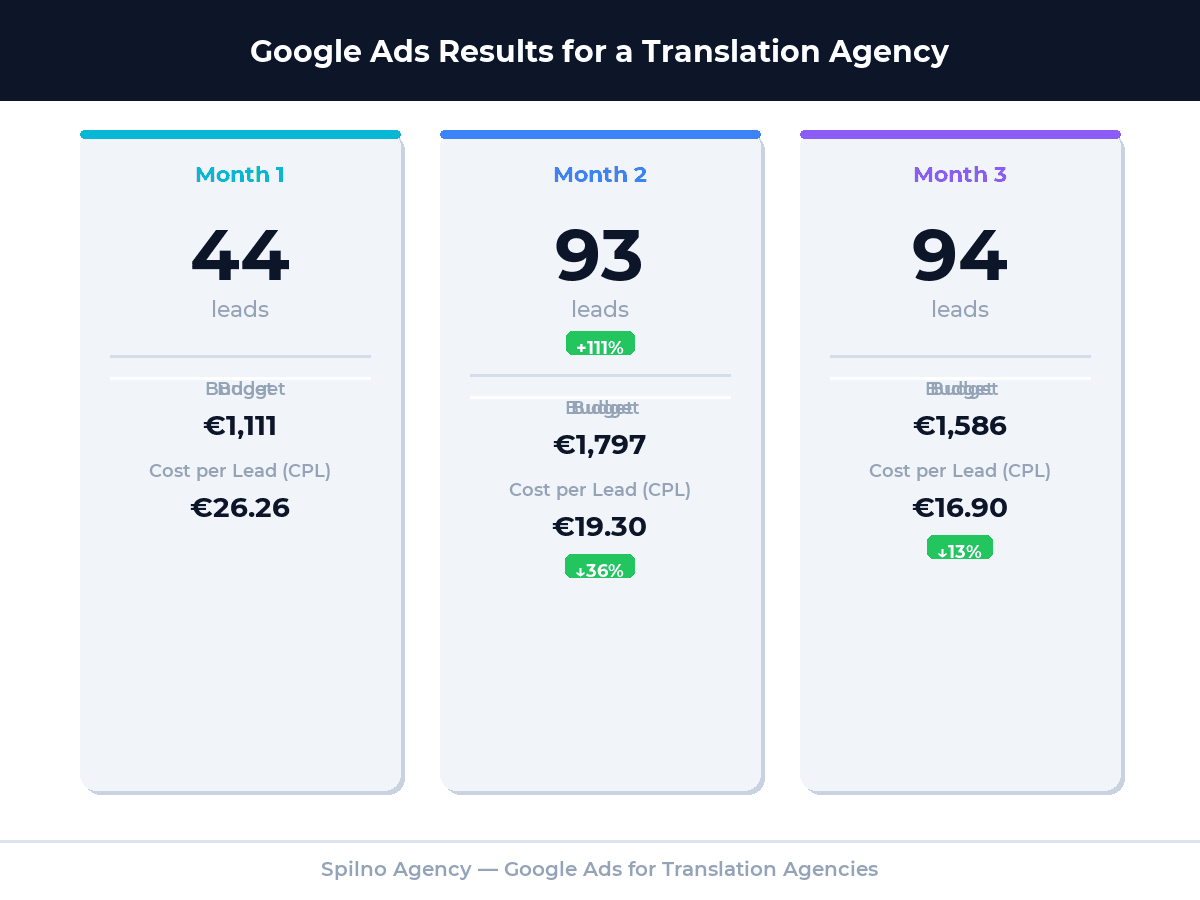
Month 1: 44 leads at a spend of €1,111.50. Cost per lead: €26.26.
Month 2: 93 leads at a spend of €1,797. Cost per lead: €19.30. The agency more than doubled the number of leads for the client while the cost per lead fell by 36%.
Month 3: 94 leads at a spend of €1,586. Cost per lead: €16.90 — a further 13% reduction through campaign optimisation. We also began testing Facebook advertising; results will be shared in the next monthly report.
Ongoing Campaign Optimisation Checklist
Optimisation is a weekly routine that delivers compounding results. Here is what we did each week to reduce CPL:
- Search term analysis. Weekly review of the Search Terms report — removing irrelevant queries and adding new negative keywords.
- Budget reallocation. Shifted budget from high-CPL campaigns to campaigns generating cheaper leads.
- A/B testing of ad copy. Compared different ad versions — kept those with higher CTR and conversion rate.
- Bidding strategy optimisation. Once sufficient conversion data was accumulated, switched from manual bidding to automated strategies (Maximize Conversions).
- Device and time analysis. Identified which days and devices produced the most conversions — adjusted bids accordingly.
- Ad copy refresh. Updated ad texts monthly — added current USPs, seasonal offers, and new extensions.
Conclusion
Google Ads is an effective tool for translation agencies. To understand this clearly, you must measure the cost per lead or customer. Since most orders in this sector come through phone calls, installing a call tracking service is non-negotiable. On average, it takes around 3 months to reach optimal performance — and the Month 2 results prove this point.
Key takeaways for translation agencies planning Google Ads:
- No measurement, no optimisation. The first step is always analytics and call tracking setup. Only then do you understand what is working.
- CPL decreases over time. Over 3 months, CPL dropped from €26.26 to €16.90 — a 36% reduction. This is the result of systematic optimisation, not chance.
- Google Ads + Meta Ads = synergy. From Month 3 we added Meta advertising as an additional channel — results to follow.
- Commercial queries = high conversion rate. The translation niche has clear commercial intent: people searching for “document translation” are ready to order immediately.
P.S. If you represent a translation bureau or company and would like to achieve the same results, leave a request on the Spilno Agency website — https://spilnoagency.com.ua/en/
More cases and examples of agency promotion can be found in the cases section.
Frequently Asked Questions
Is Google Ads effective for translation agencies?
Yes, Google Ads works well for translation agencies because queries like “document translation” and “translation bureau” carry strong commercial intent. The key is selecting the right keywords and setting up geo-targeting correctly.
How do you set up Google Ads for a translation agency?
For a translation agency in Google Ads: collect semantics (translation + language + document type), split campaigns by language pair, set up call and form tracking, and use location and phone extensions.
How much does a click cost for translation services advertising?
Click costs in the translation niche vary — typically €0.10–€0.80 depending on query competitiveness, region, and language pair. Highly specialised queries (legal, technical translation) tend to cost more.
Google Ads or SEO — which is better for a translation bureau?
Google Ads delivers fast results but requires ongoing budget. SEO builds organic traffic over the long term. The optimal strategy is to combine both: Google Ads for rapid client acquisition, SEO to reduce lead costs over time.
How do you measure advertising effectiveness for a service business?
For a service business, track: call volume and cost (call tracking), website form submissions, CPA (cost per customer acquisition), and ROAS. Set up conversions in GA4 and import data into Google Ads.

Read also
How to Track Revenue, Transactions and Purchases in Google Analytics 4 from WordPress WooCommerce
Introduction WooCommerce store owners are often convinced that Google Analytics 4 already shows them revenue, transaction counts and…
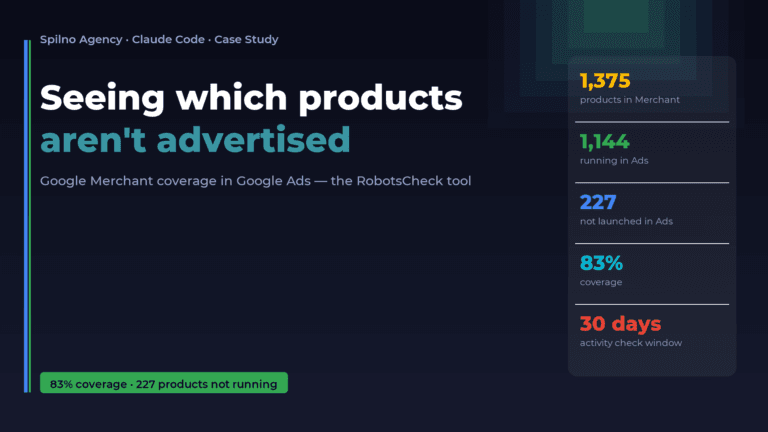
How Claude Helps Spilno Agency: Google Merchant Coverage in Google Ads
An online store lists 1,375 products in Google Merchant — but how many of them are actually running…
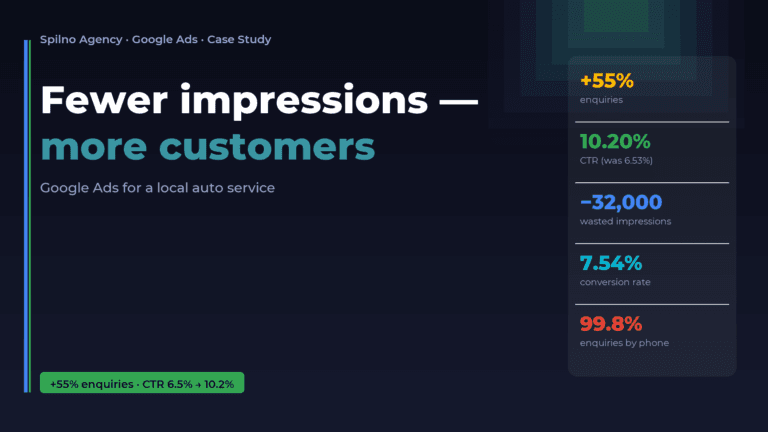
Google Ads for a Local Auto Service: Fewer Impressions, More Customers (Case Study)
A local auto service was spending its ad budget on tens of thousands of cheap impressions that barely…