Case Study: Diesel Car Service Promotion — Google Ads Optimisation in Odesa

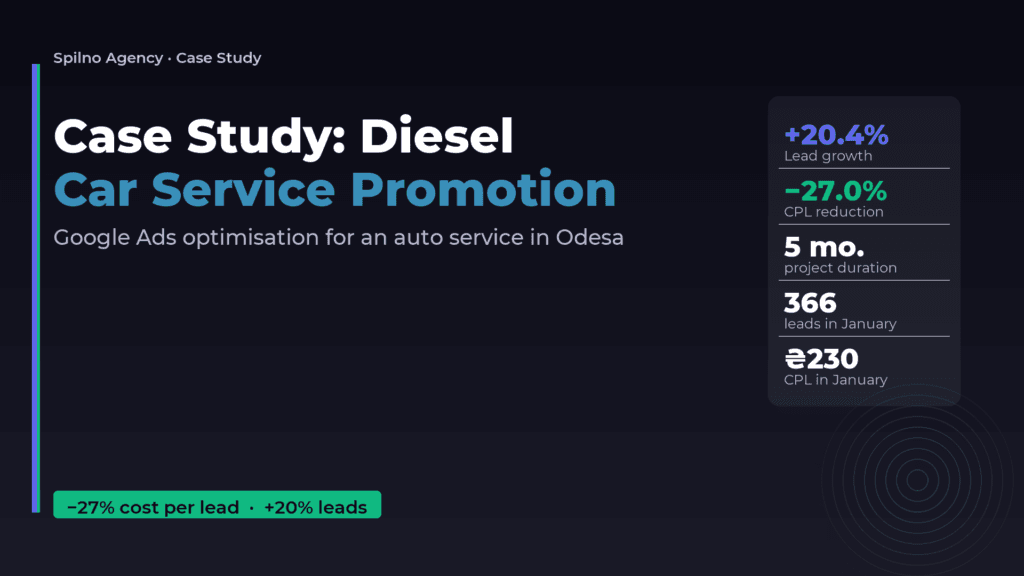
A diesel car service in Odesa approached Spilno Agency to improve the efficiency of their Google Ads. Over 5 months of optimisation, cost per lead dropped by 27% — from ₴315 to ₴230 — while monthly leads grew by 20%, from 304 to 366.
About the Client
The client is a diesel car service in Odesa specialising in high-pressure fuel pump (HPFP) repair and fuel system diagnostics. Their narrow specialisation is a competitive advantage: the workshop services vehicles with diesel engines — Mercedes, BMW, Volkswagen, Audi — and commercial transport.
- HPFP diagnostics on BOSCH, SIEMENS, DENSO, CUMMINS, and DELPHI test benches.
- Repair and testing of fuel pumps, injectors, and fuel rails.
- Fuel tank and fuel line inspection, fuel filter replacement.
- Warranty on all completed work.
The Challenge: Poor Ad Efficiency and Weak Communication
Before working with us, the client either managed ads independently or used a different contractor. The main issues we identified:
- Inefficient budget allocation: spend was concentrated on broad, low-converting queries.
- No analytics: Google Analytics 4 was not configured — leads were not being tracked.
- Mixed campaigns: different services (HPFP, injectors, fuel tank) were grouped into a single campaign with no segmentation.
- Communication gaps: no regular reporting, slow response to market changes.
Strategy and Solution
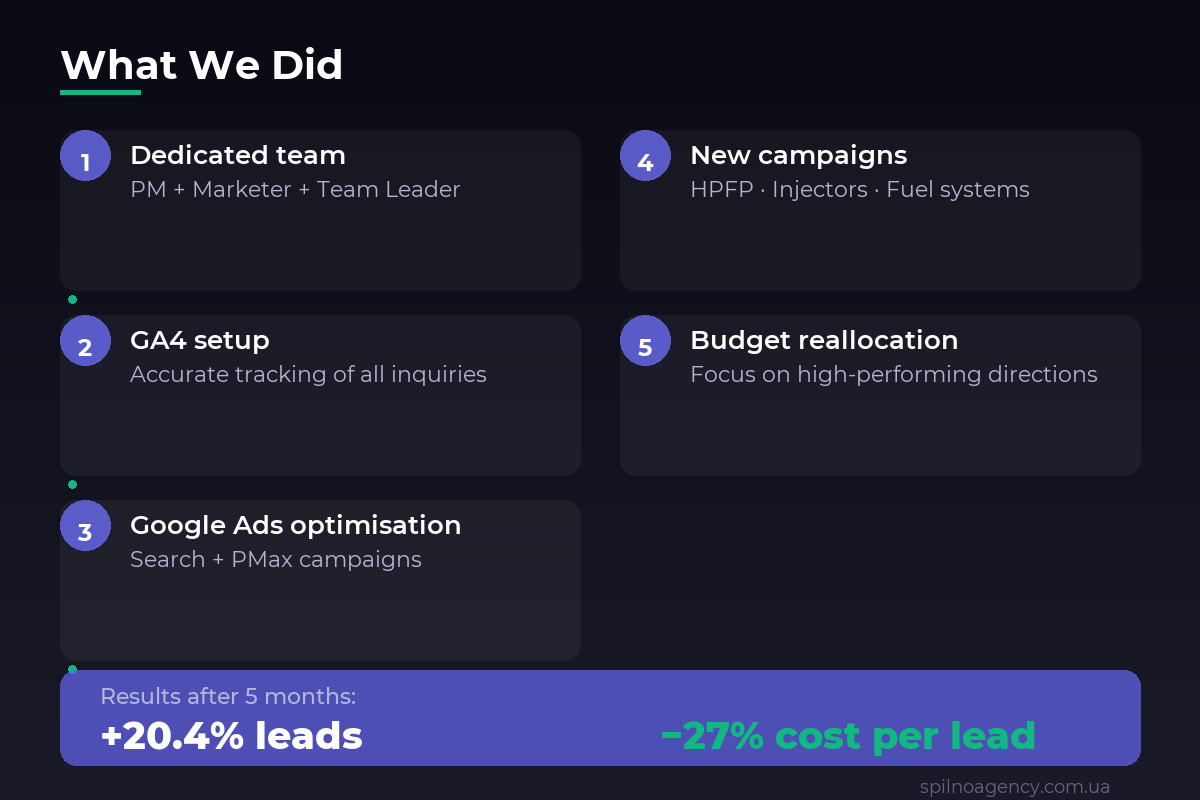
1. Dedicated Project Team
A dedicated team was assigned to the project:
- Project Manager — handles client communication, coordination, and task control.
- Internet Marketer — manages ad accounts, analyses performance, and implements optimisations.
- Team Leader — sets the overall promotion strategy and approves key decisions.
Bi-weekly client meetings, weekly reports, and rapid response to changes are the standard at Spilno Agency.
2. Google Analytics 4 Setup
The first step was building an analytics infrastructure. Without accurate tracking, it is impossible to know which campaigns deliver real clients. We configured:
- Form submission tracking for the website’s inquiry form.
- Call tracking to attribute inbound calls to their traffic source.
- Remarketing audiences in GA4 for retargeting campaigns.
- Offline conversion import into Google Ads to optimise campaigns for real leads.
3. Google Ads Campaign Restructure
After auditing the ad account, we performed a full campaign restructure:
- Budget reallocation — cut spend on broad non-converting queries, increased bids on converting keywords.
- Separate campaigns for each service: HPFP diagnostics, injector repair, fuel system inspection, fuel rail repair.
- Ad copy refresh — rewrote all ad texts with emphasis on specialisation, warranty, and location (Odesa).
- Performance Max (PMax) — launched PMax campaigns to capture additional demand.
- Negative keywords — removed non-target traffic (DIY queries, parts searches, training).
Month-by-Month Results: August to January
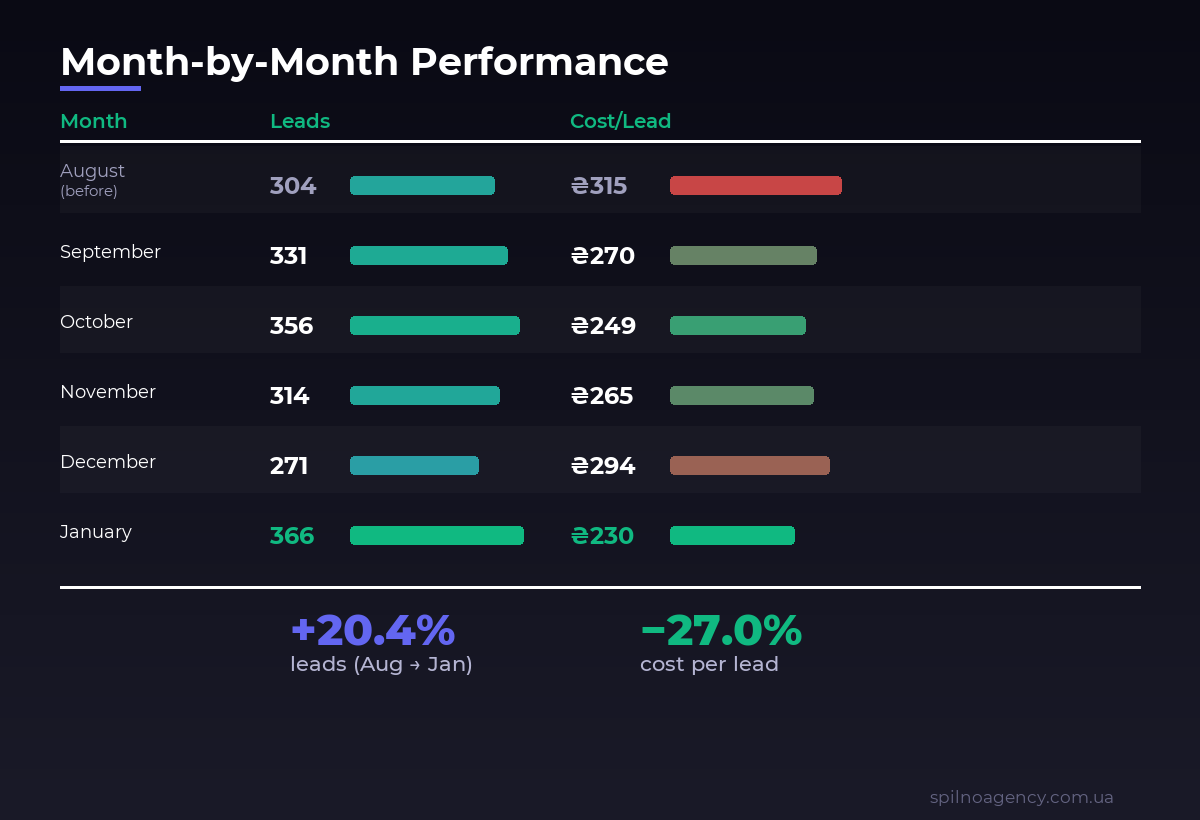
Comparing performance before the engagement (August) with after 5 months of optimisation (September–January):
| Month | Leads | Cost per Lead (₴) |
|---|---|---|
| August (before Spilno) | 304 | 315 |
| September | 331 | 270 |
| October | 356 | 249 |
| November | 314 | 265 |
| December | 271 | 294 |
| January | 366 | 230 |
Key Metrics: 5-Month Summary
- Lead growth: +20.4% (304 → 366 per month)
- Cost per lead reduction: −27.0% (₴315 → ₴230)
- Budget saved per lead: ₴85 — at 366 leads per month, that is ₴31,110 saved monthly
- Client satisfied with communication quality and reporting transparency
Why It Worked
- Analytics first. Without GA4 and call tracking, it was impossible to understand actual campaign performance. Building the analytics layer was the foundation for all subsequent decisions.
- Service-level segmentation. Separate campaigns for HPFP, injectors, and fuel systems allowed maximum ad relevance and higher CTR.
- Continuous optimisation. Weekly search term analysis, bid adjustments, and ad copy testing drove consistent CPL improvement throughout the project.
Next Steps: Scaling the Result
- SEO — optimising the website for local queries (“diesel engine repair Odesa”, “HPFP repair Odesa”) to generate free organic traffic.
- Meta Ads — launching Facebook and Instagram advertising for retargeting site visitors and targeting diesel vehicle owners by demographic interest.
- Google Business Profile — in-depth optimisation of the business listing to increase visibility in local search.
Conclusion
Over 5 months, Spilno Agency helped a diesel car service in Odesa transform its advertising strategy: built the analytics foundation, restructured Google Ads campaigns, and established transparent communication. The result — +20% leads and −27% CPL on the same budget.
Need effective advertising for your car service or auto workshop? Contact us for a free audit and a tailored strategy.
Frequently Asked Questions
How to advertise a specialised diesel car service?
For a diesel car service: use Google Search Ads targeting high-intent queries with diesel + service type + location, optimise your Google Business Profile with diesel-specific categories and reviews, use Facebook Ads for retargeting website visitors, and add call tracking to measure inbound calls accurately.
What Google Ads strategy works best for specialised auto services?
For specialised services (diesel, HPFP, ADAS, transmission): use narrow exact match and phrase match keywords to minimise wasted spend. Create dedicated ad groups per service. Use ad scheduling to focus budget on peak inquiry hours. Call extensions are essential for service businesses.
How to track leads from car service advertising?
Implement GA4 with form submission tracking and call tracking (dynamic number insertion) to attribute calls to their source. Use Google Ads offline conversion import for deals closed via phone. This gives you accurate CPL per channel and campaign.
What ROI is realistic for Google Ads for an auto service?
ROI for car service ads depends on average order value, conversion rate, and geographic competition. Calculate CPL first, then compare to average revenue per job. In our diesel service case study, CPL dropped from ₴315 to ₴230 over 5 months — a 27% reduction.
How to use Google Business Profile to attract more car service clients?
Optimise your GBP: add all service categories, upload photos of the workshop and completed work, respond to all reviews, enable messaging and booking, post updates regularly. A fully optimised GBP profile can generate free leads equivalent to a modest Ads budget.

Read also
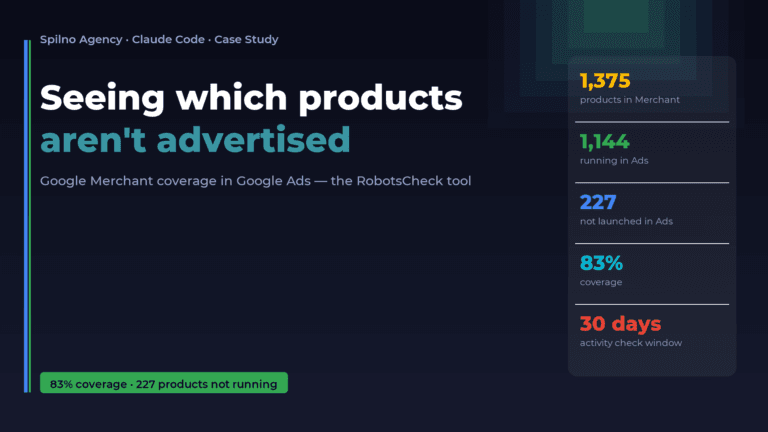
How Claude Helps Spilno Agency: Google Merchant Coverage in Google Ads
An online store lists 1,375 products in Google Merchant — but how many of them are actually running…
Google Ads for a Local Auto Service: Fewer Impressions, More Customers (Case Study)
A local auto service was spending its ad budget on tens of thousands of cheap impressions that barely…
B2B Manufacturer Case Study: 129 Leads and 2.09x ROI with Meta Ads
A European roofing and facade materials manufacturer approached Spilno Agency with a clear goal — build a B2B…