Promoting an English Language School — Google Ads Case Study

A children’s English language school reduced the cost of a quality lead by 45% — from $50 to $27 — in just two months. Here’s how we set up Google Ads, why we dropped Performance Max, and what actually delivered results.
About the Client and the Goal
The client is a private English language school for children. The objective: fill a group for a new course. Before working with us, the client had run advertising independently on Meta Ads — but with no transparent reporting. It was impossible to tell whether ads were profitable or what each new student actually cost.
We proposed starting with Google Ads to test a new channel with measurable results. The first goal: capture existing demand (people already searching for English courses for children) and generate leads with clear attribution by source.
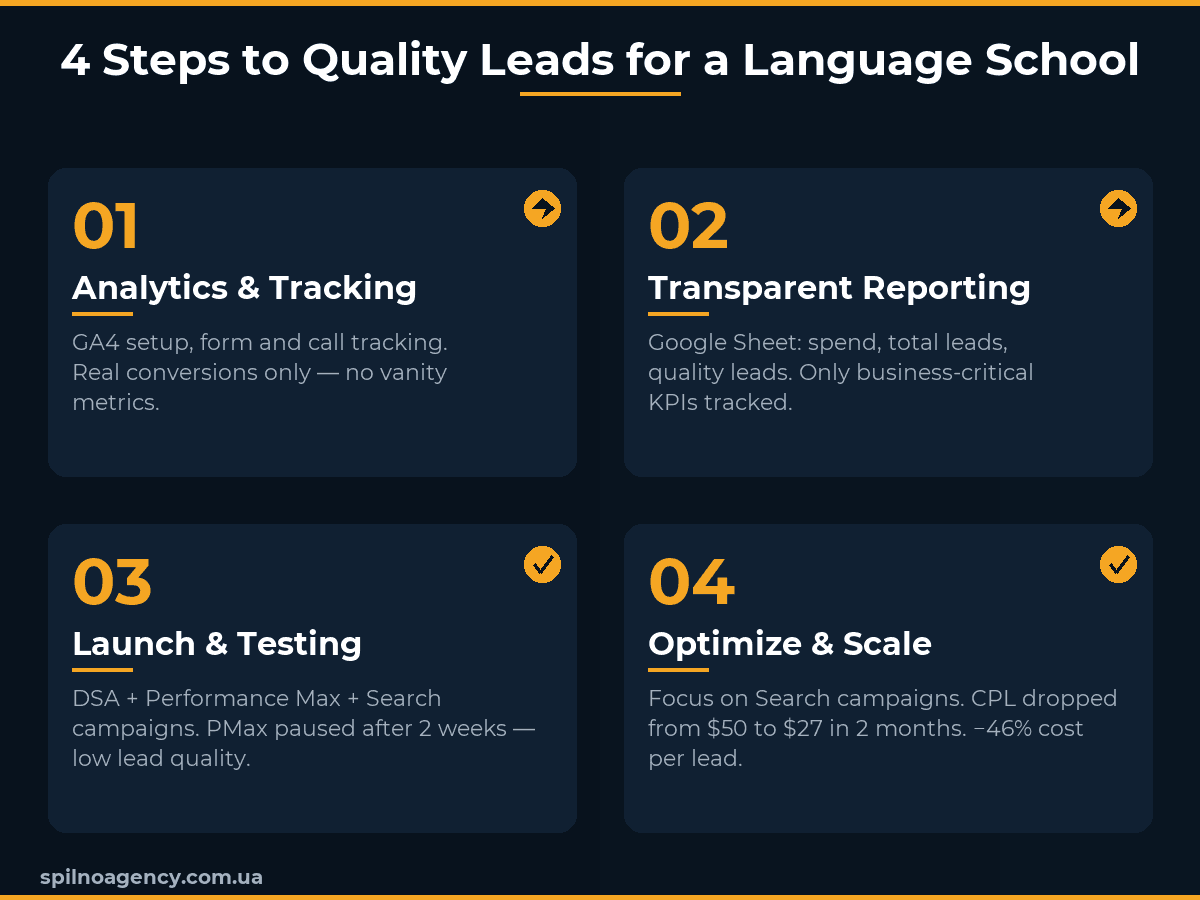
Step 1. Analytics and Conversion Tracking
The first thing we do for every client before launching ads is set up and verify analytics. Without this, any advertising spend is unaccountable.
We configured:
- Website form submission tracking via Google Analytics 4
- Phone call tracking
- Conversion import into Google Ads to train campaign algorithms
We deliberately do not track phone clicks, social media clicks, or other vanity metrics. Why? They don’t reflect actual business outcomes and can misdirect Smart Bidding algorithms toward low-value signals. We only track actions that directly lead to a booked lesson.
Step 2. Transparent Reporting
Alongside analytics, we built a reporting framework — a Google Sheet tracking three key metrics:
- Ad spend — how much was invested each week and month
- Total leads — all form submissions and call enquiries
- Quality leads — those who actually booked a trial lesson
Cost per quality lead (CPL) became the primary KPI. This is our standard: no noise, only metrics that matter to the business.
Step 3. Google Ads Strategy and Launch
For the English language school we launched three campaign types:
- Search campaigns — for direct, high-intent queries (“English courses for children”, “online English school”)
- DSA campaigns (Dynamic Search Ads) — to capture relevant queries not covered manually
- Performance Max — for reach across all Google channels (YouTube, Gmail, Display, etc.)
Within 5 days of launch, the first leads arrived. The system began learning.
Step 4. Optimization — Why We Paused Performance Max
Two weeks in, a clear pattern emerged: Performance Max was generating a high volume of leads, but lead quality was poor — people were not converting to trial lesson bookings.
We made the decision to pause PMax and redirect the full budget to Search and DSA campaigns. The reason: PMax was pulling in traffic from broader segments (Display, YouTube) where purchase intent is significantly lower than in search. For services with a long decision cycle — like children’s education — this matters critically.
Instead of PMax, we focused on:
- Precise commercial queries in Search (high purchase readiness)
- Expanded negative keyword lists to filter irrelevant traffic
- Ad copy A/B testing
- Ad schedule optimisation (removing low-performing time slots)
Results After 2 Months
Here’s what we achieved:
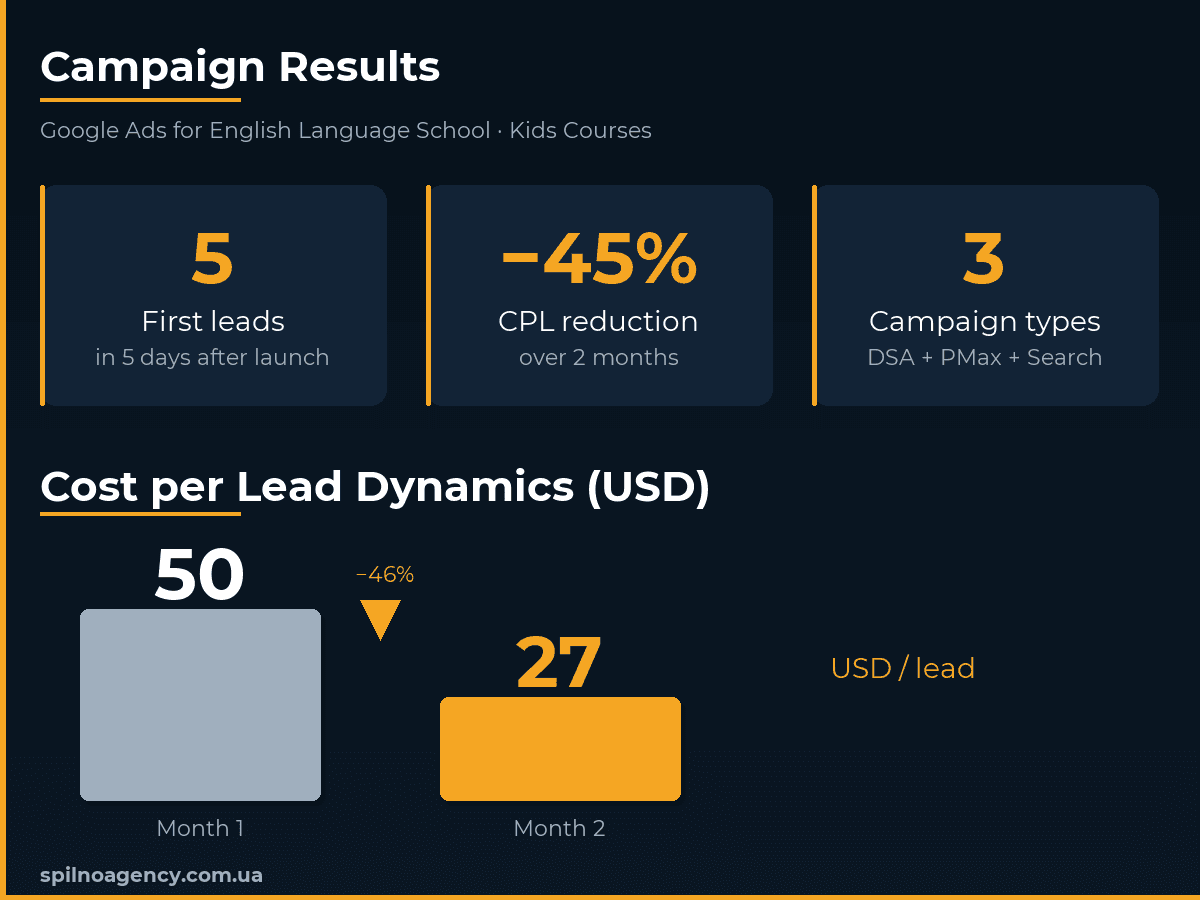
- First leads — within 5 days of campaign launch
- CPL month 1: $50 per quality lead (trial lesson booking)
- CPL month 2: $27 — a 46% reduction
- According to the client, the CPL from Google Ads is comparable to Meta Ads — but now there is full transparency and clear attribution
The key insight: the cost per quality lead from Google Ads was similar to the Meta Ads the client had run independently before. But the critical difference now is complete transparency — every lead is tracked, every dollar of spend is documented.
Key Takeaways
From this case study, we drew several conclusions we now apply across all education-sector clients:
- Performance Max is not always right for education services. In niches with a long decision cycle, lead quality matters more than volume.
- Analytics before advertising is non-negotiable. Without GA4 and conversion tracking, we wouldn’t know which campaigns were actually working.
- Transparent reporting builds client trust and enables faster optimisation decisions.
- High-intent Search queries deliver better lead quality for services requiring a personal meeting or trial session.
- Negative keywords are underrated. The right negative keyword list reduces CPL without increasing budget.
How We Work with Language Schools
Promoting education businesses is our specialism. We understand the nuances: seasonality (September and January are peak enrolment periods across Europe), competition from large networks, the importance of teacher personal branding, and the role of social proof.
Our approach for schools and courses:
- Analytics and conversion tracking configured before any campaign goes live
- Google Ads Search targeting commercial queries with geo-targeting
- Meta Ads retargeting for website visitors who didn’t convert
- Landing page optimisation to improve lead-to-enrolment conversion
- Monthly reporting with real business KPIs — not vanity metrics
Want to attract quality students to your school or courses? Contact us — we’ll walk you through how this works in practice.
Request for marketing consultation
Frequently Asked Questions
How to promote an English language school online?
The most effective channels: Google Ads Search for commercial queries, Meta Ads for retargeting and lookalike audiences, Google Business Profile for local visibility, and SEO for long-term organic traffic.
Google Ads or Facebook Ads for language courses — which to choose?
Google Ads captures people already searching for courses. Facebook and Instagram Ads build demand and awareness. The optimal strategy combines both channels — Google Ads for intent-based search traffic, Meta for retargeting and lookalike expansion.
How much does a lead cost for an English school via Google Ads?
In our case study, the cost of a quality lead dropped from $50 to $27 over two months — a 46% reduction. Actual CPL depends on market competition, landing page quality, and the precision of your targeting.
Why should you pause Performance Max for a language school?
PMax generated high lead volume but poor quality — people weren’t converting to trial lesson bookings. After pausing PMax and concentrating budget on Search campaigns, lead quality improved and CPL dropped 46%. For education services, lead quality matters more than quantity.
How to attract more students to an English language school?
Proven approach: a free trial lesson as a lead magnet, Google Ads Search targeting high-intent queries, precise GA4 conversion tracking, Meta Ads retargeting for non-converting visitors, and authentic student testimonials to build trust.

Read also
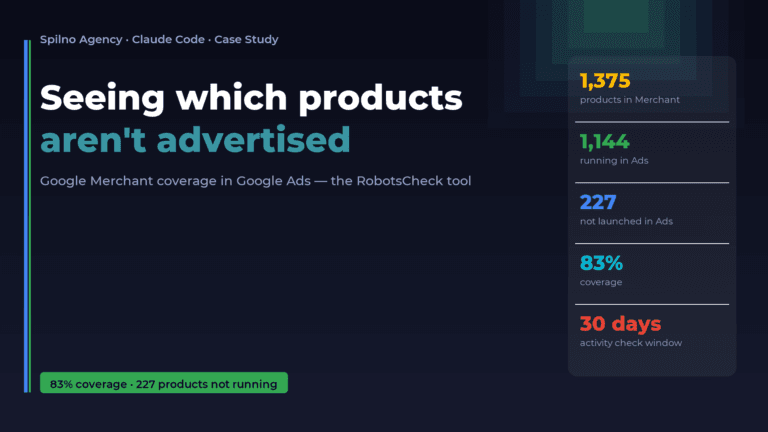
How Claude Helps Spilno Agency: Google Merchant Coverage in Google Ads
An online store lists 1,375 products in Google Merchant — but how many of them are actually running…
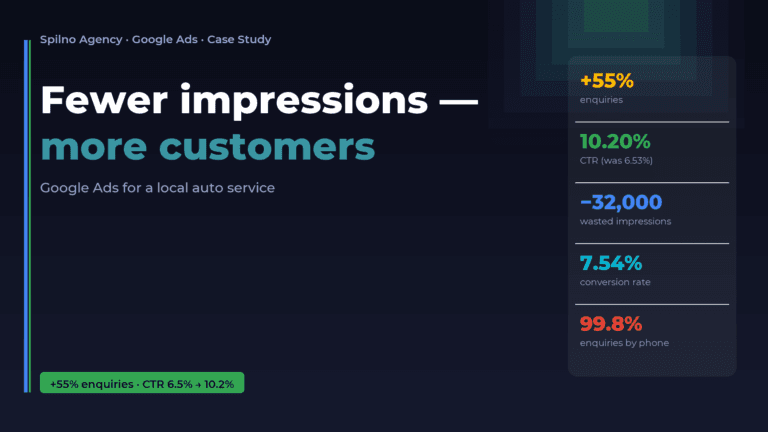
Google Ads for a Local Auto Service: Fewer Impressions, More Customers (Case Study)
A local auto service was spending its ad budget on tens of thousands of cheap impressions that barely…
Google Merchant API Changes: Migrate or Request an Extension by August 18, 2026
On August 18, 2026 Google sunsets the Content API for Shopping — migrate to the Merchant API or…