Is an SEO specialist responsible for leads and sales? Our position

An SEO specialist doesn’t close the deal and isn’t on the sales call. But if they feel no moral responsibility for whether traffic turns into leads, how likely is it that their SEO strategy is actually built around leads and sales — rather than around traffic for its own sake? At Spilno Agency, our answer is: yes, they are responsible. Here’s why, and an invitation to disagree with us.
Where this discussion started
A few days ago, our colleague Valerii Krasko posted a short but pointed question on LinkedIn: should an SEO specialist be responsible for the sales and leads that come from the SEO channel. He answered it himself, on behalf of the agency: yes. The post is in Ukrainian — our home market — but the question is the same everywhere SEO gets sold as a service. It gathered dozens of comments, roughly split down the middle.
Here are a few reactions straight from the comments under the post:
- Yurii Kersan: too many factors affect sales — price, brand, demand. If an SEO specialist is held responsible for that, why have a marketer at all? Draws a parallel with a PHP developer, who also isn’t accountable for the site’s leads.
- Vitaliy Besedin: if you’re going to assign responsibility, then give the SEO specialist a results-based bonus and carte blanche to change the site. “I believe the answer is yes.”
- Stepan Orda: without a single owner of the whole funnel, it’s hard to optimize budget and get results.
- Maksym Bykov: depends on the niche — cites gambling as an example, where users arrive through referral partners rather than directly from organic search.
- Mariia Sydorchuk: “yes and no — it depends on a lot of factors.”
- Yurii Kucherenko: asked for clarification on exactly which sales or lead action an SEO specialist should be responsible for — the question we try to unpack below.
We grouped these and other arguments into two camps, then explain why the agency takes the position it does. You can read the full discussion (32 comments) under the original LinkedIn post.
Two camps
“SEO is only responsible for traffic”
The argument sounds reasonable: an SEO specialist doesn’t design the landing page, doesn’t write the offer, doesn’t negotiate with the client, and doesn’t set the price. Turning traffic into a lead is a landing page and UX problem; turning a lead into a sale is the sales team’s problem. SEO controls neither, so holding it accountable for the final outcome feels unfair.
“SEO is part of the funnel, not just a traffic supplier”
The other camp pushes back: if an SEO specialist deliberately ignores everything that happens to traffic after the click, they’re optimizing the wrong metric. You can bring 10,000 visitors to a page that doesn’t sell, hit your ranking and traffic KPIs on paper, and still fail the business problem the SEO channel exists to solve.
Spilno Agency’s position
We deliberately side with the second camp — with three clarifications that, in our view, address most of the pushback.
- SEO is part of the marketing team, not a separate contractor. The marketing department owns the task — and the responsibility — of generating leads. An SEO specialist works inside that team, not alongside it. So a share of that responsibility (moral, not legal) belongs to them too, the same way it belongs to a paid media manager or a content marketer.
- Traffic for its own sake isn’t a strategy. Turning traffic into leads and sales should shape the SEO strategy itself — which query clusters get priority, which pages get reinforced, which search intent gets addressed first. If an SEO specialist doesn’t track this, or doesn’t see it as their job, how likely is it their strategy actually leans on leads and sales rather than just rankings and traffic volume?
- The question isn’t “who takes the fall” — it’s what “responsibility” even means. SEO specialists almost always hear “responsibility” as legal — as if we’re talking about penalties or a terminated contract for a missed sales target. But we mean moral responsibility: the habit of asking “what happened to this traffic next” — and looking for the answer in the metrics instead of shrugging it off.
Legal responsibility ≠ moral responsibility
This is probably the biggest misunderstanding in the whole discussion. Nobody is suggesting an SEO specialist’s pay should be tied to a sales target, or that they should be penalized for a low-converting landing page — too many factors outside SEO influence that number. The real question is different: does the specialist see it as their business to ask “why isn’t this traffic converting” — even when the answer sits outside their control.
Moral responsibility isn’t about taking the blame for someone else’s mistakes. It’s about whether an SEO specialist looks at the whole funnel or stops at rankings and clicks. The first builds a strategy oriented toward the business outcome. The second builds a strategy oriented toward the report.
What this looks like in practice
- Prioritizing query clusters by commercial intent and actual page conversion, not just search volume.
- Checking GA4/CRM data as routinely as Search Console — and pausing further investment in a cluster that brings traffic but no leads.
- Aligning content and internal linking recommendations with sales or the business owner: which queries actually turn into deals, and which just “browse.”
- Reporting to a client or a manager that includes not just rankings and traffic, but their connection to lead generation — even when the final sale sits outside SEO’s control.
Where we draw the line
The “SEO is only responsible for traffic” camp is right about one thing: treating an SEO specialist like a sales manager goes too far. They don’t control price, lead handling quality, how fast a sales rep responds, or market conditions. SEO genuinely isn’t accountable for those — neither legally nor morally. The distinction we draw: not being accountable for another team’s outcome is fine; not caring what happens there is not.
A question for you
We’re deliberately not closing this out. Valerii’s post gathered 32 comments in a few days, and the arguments there are far more varied than two camps can hold. So we’re asking here too:
- Do you track how your SEO traffic turns into leads — or do you stop at rankings and clicks?
- Where do you draw the line on an SEO specialist’s moral responsibility?
- Has that sense of responsibility ever changed your actual strategy — not the tactics, but which clusters you prioritize?
Share your view in the comments on the original LinkedIn post or under this article — we’ll round up the most interesting arguments in a follow-up piece.

Read also
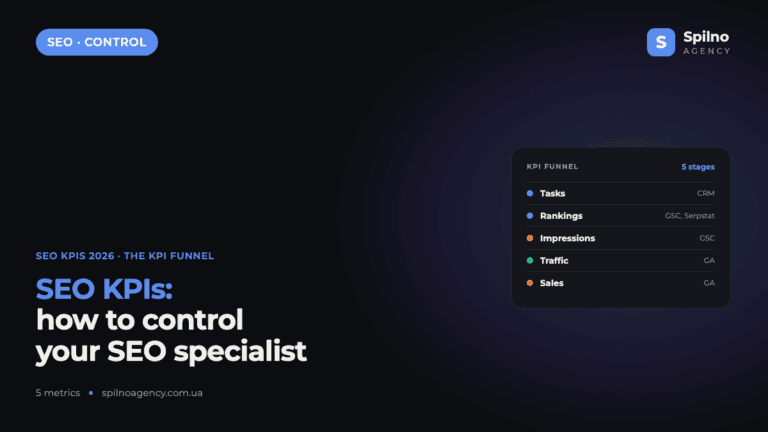
How to Control an SEO Specialist: The 5-Stage SEO KPI Funnel
SEO KPIs form a chain of five metrics that show, step by step, whether your SEO is actually…
Best CMS for an Online Store: Cloud vs Self-Hosted Platforms in 2026
Compare Shopify, WooCommerce, PrestaShop, OpenCart and Magento for your online store. Pros, cons, and a step-by-step CMS selection…

LinkedIn Ads Library: How to Find Your Competitors’ LinkedIn Ads (2026 Guide)
How to use the LinkedIn Ads Library to see any competitor's sponsored content for free — step by…