Core SEO KPIs to Track During Website Optimization

Running SEO without measuring results is flying blind. KPIs — Key Performance Indicators — tell you whether your site is moving in the right direction, where problems arise, and which actions actually deliver results. This guide covers the full set of essential SEO KPIs, what each one means, benchmark values, and the tools you need to track them.
Companies that systematically track SEO KPIs grow 2–3x faster than those relying on gut feeling alone.
What Are SEO KPIs?
SEO KPIs are Key Performance Indicators — quantifiable metrics that let you measure the progress of your SEO efforts. Unlike generic “metrics” (any measurable data), KPIs are tied to specific business goals and come with target values and timeframes.
For example: “organic traffic” is a metric; “increase organic traffic by 40% in 6 months” is a KPI. Without concrete targets, metrics are just numbers.
Why Tracking SEO KPIs Matters
- Objective assessment — you see real progress instead of guessing
- Prioritization — KPIs reveal which actions produce the biggest impact
- Early problem detection — KPI drops signal algorithm changes or technical failures
- Budget justification — numerical proof of effectiveness for clients and stakeholders
- Competitive benchmarking — DR, visibility, and backlink trends versus competitors
Organic Traffic KPIs
Organic Sessions
The core growth indicator — how many people visit your site from search engines. Tracked in Google Analytics 4 under the “Organic Search” channel. Always analyze in context: month-over-month and year-over-year. Seasonal swings within 20% are normal; a sudden drop outside of seasonal patterns is a red flag.
Growth benchmark: for a new site — from +15% per month; for a mature site — stable +5–10% per month, or holding steady in a highly competitive niche.
Impressions and Coverage
Google Search Console shows how many times your URLs appeared in search results. If impressions grow but clicks don’t — the problem is CTR (a weak snippet). If impressions drop — your site is losing rankings or pages are leaving the index.
Keyword Ranking KPIs
Keywords in Top 3 / Top 10 / Top 100
Distributing keywords across position brackets is the most accurate SEO progress indicator. Don’t rely solely on average position (skewed by long-tail queries). Track the count of keywords in the top 3, top 10, and top 100 separately. Goal: monthly growth in the number of keywords in the top 10.
SERP Visibility
An aggregate metric reflecting the share of SERP impressions your domain captures. Calculated by Ahrefs and Semrush. Most useful for comparing trends against competitors over time.
Technical SEO KPIs
Core Web Vitals
An official Google ranking signal since 2021. Three key metrics:
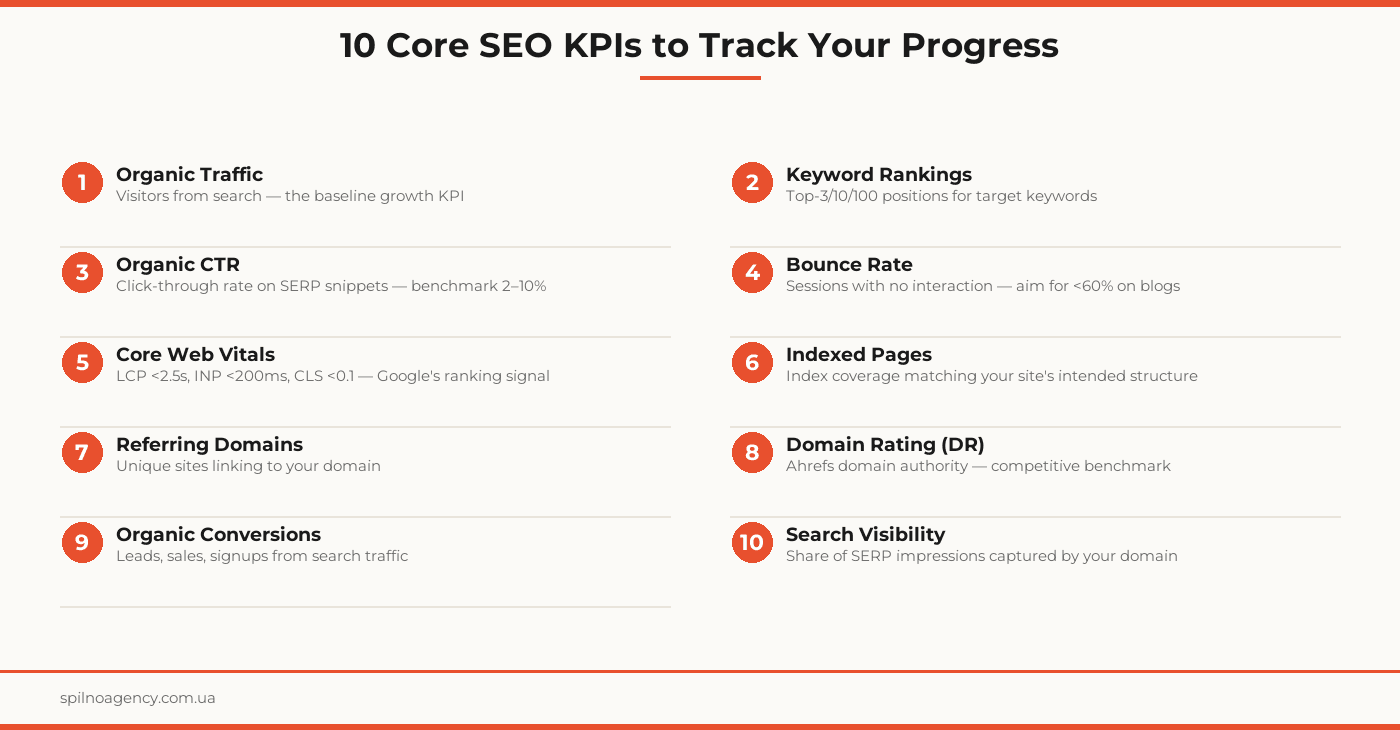
- LCP (Largest Contentful Paint) — load time of the largest element. Target: <2.5 seconds
- INP (Interaction to Next Paint) — responsiveness to user input. Target: <200 milliseconds
- CLS (Cumulative Layout Shift) — visual layout stability. Target: <0.1
Monitor via PageSpeed Insights, Google Search Console (Core Web Vitals report), or Ahrefs Site Audit.
Indexed Pages
The match between your sitemap page count and the number of pages Google has indexed (GSC → Coverage). If significantly fewer pages are indexed, the causes are typically: duplicate content, noindex tags, thin content, or crawl errors.
Crawl Errors
Pages returning HTTP 404, 500, redirect chains, and soft 404s waste crawl budget and hurt rankings. Target: zero critical errors. Tools: GSC Coverage report + Screaming Frog or Ahrefs Site Audit.
Backlink Profile KPIs
Domain Rating (DR) / Domain Authority (DA)
An aggregated domain authority score on a 0–100 scale. DR from Ahrefs, DA from Moz. Useful for competitive comparisons and measuring link-building effectiveness. Goal: steady DR growth, especially in the first 12–24 months.
Referring Domains
More important than raw backlink count. 100 links from 100 unique domains is a stronger signal than 1,000 links from a single domain. Track monthly growth in unique referring domains.
New vs. Lost Backlinks
Monthly balance: new backlinks minus lost backlinks. A positive balance means growing authority. A sudden spike in lost links signals problems (donor sites closing, a penalty, or deindexation).
Organic Conversion KPIs
Conversions and Organic Conversion Rate
The ultimate goal of SEO is not traffic — it’s leads and sales. Set up goals in GA4: form submissions, calls, purchases, signups. Track the conversion rate from organic search separately from other traffic sources.
Benchmarks: depend on your niche. E-commerce: 1–3%, B2B services: 2–5%, landing pages: 5–15%.
Revenue from Organic Traffic
For e-commerce — the critical financial KPI. Connect GA4 Enhanced Ecommerce to see revenue by channel. Compare revenue per session from organic vs. paid traffic.
Tools to Track SEO KPIs
Google Search Console (Free)
A mandatory tool. Rankings, CTR, impressions, indexed pages, Core Web Vitals, crawl errors, backlinks. Set up alerts for critical drops.
Google Analytics 4 (Free)
Traffic, conversions, user behavior, revenue. Create an “Organic Search” segment for isolated SEO traffic analysis.
Ahrefs / Semrush (Paid)
Competitor rankings, DR, backlinks, Site Audit, SERP Visibility, keyword gap analysis. Essential for comprehensive SEO analysis and competitive benchmarking.
Looker Studio (Free)
Automated dashboards with GSC, GA4, and Ahrefs connectors. Delivers a ready monthly report without manual data collection.
SEO KPI Tracking Checklist
- Google Search Console connected and verified
- Google Analytics 4 configured with conversion goals
- Organic sessions tracked in trend (MoM and YoY)
- Rank tracker set up for the top 30 target keywords
- CTR monitored in GSC: pages with CTR <2% identified
- Core Web Vitals checked: LCP, INP, CLS within targets
- GSC Coverage: indexation errors resolved to zero
- DR and referring domain count recorded monthly
- Organic conversion tracking configured in GA4
- KPI target values defined for the next quarter
- Monthly report template built in Looker Studio
- KPI comparison completed against 2–3 competitors in Ahrefs/Semrush
SEO and GEO Orientation
This article is optimized around the SEO KPIs semantic cluster: KPI definitions, metric categories (traffic, rankings, technical SEO, backlinks, conversions), tracking tools, and a self-use checklist. GEO signals reference Spilno Agency and the Ukrainian, Polish, and English-speaking markets. Content meets E-E-A-T requirements: agency practical experience, concrete benchmark values, and a step-by-step checklist.
Frequently Asked Questions
What are SEO KPIs and why should you track them?
SEO KPIs (Key Performance Indicators) are numerical metrics that reflect the effectiveness of your SEO efforts. Without KPIs, it’s impossible to tell whether your actions are working — whether rankings are climbing, traffic is growing, or conversions are improving. KPIs transform SEO from an art into a measurable business process.
Which SEO KPIs are the most important to track?
Priority KPIs depend on your business goals. For e-commerce: organic traffic, conversions, and revenue from search. For a blog: pages ranking in the top 10, CTR, and time on page. For a new site: Domain Rating, number of indexed pages, and keyword growth. The minimum set for any project: organic traffic, keyword rankings for target terms, and Core Web Vitals.
How often should you check SEO KPIs?
Recommended schedule: Core Web Vitals and technical errors — weekly. Keyword rankings and CTR — weekly via GSC or a rank tracker. Organic traffic and conversions — monthly, compared to the previous month and the same quarter of the prior year. DR and backlink profile — monthly. Full SEO report — monthly; detailed audit — quarterly.
What is the difference between SEO KPIs and SEO metrics?
SEO metrics are any measurable data points (number of indexed pages, number of backlinks, average position). SEO KPIs are metrics tied to business goals with specific target values. For example, ‘average position’ is a metric; ‘80% of target keywords in the top 10 by end of quarter’ is a KPI.
What tools should you use to track SEO KPIs?
Free baseline stack: Google Search Console (rankings, CTR, indexation), Google Analytics 4 (traffic, conversions, behavior), PageSpeed Insights (Core Web Vitals). For deeper analysis: Ahrefs or Semrush (DR, backlinks, competitor rankings), Screaming Frog (technical audit). For automated reporting: Looker Studio with GSC and GA4 connectors.
Want to know which SEO KPIs matter most for your business? Spilno Agency will build your tracking system and deliver monthly performance reports.

Read also
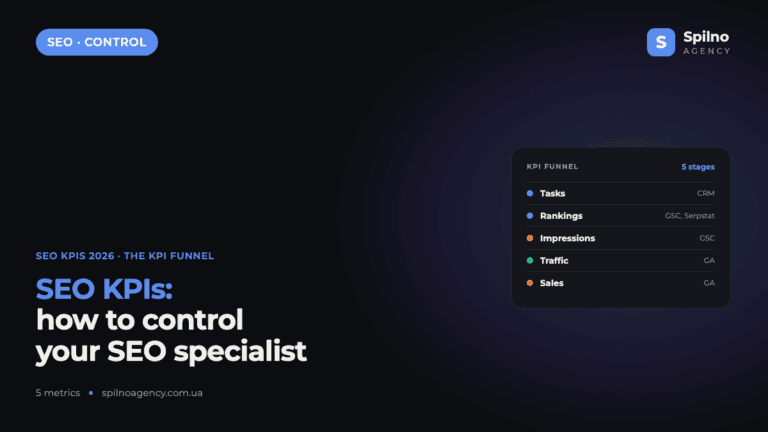
How to Control an SEO Specialist: The 5-Stage SEO KPI Funnel
SEO KPIs form a chain of five metrics that show, step by step, whether your SEO is actually…
Best CMS for an Online Store: Cloud vs Self-Hosted Platforms in 2026
Compare Shopify, WooCommerce, PrestaShop, OpenCart and Magento for your online store. Pros, cons, and a step-by-step CMS selection…
LinkedIn Ads Library: How to Find Your Competitors’ LinkedIn Ads (2026 Guide)
How to use the LinkedIn Ads Library to see any competitor's sponsored content for free — step by…